
Mary Shelley’s Frankenstein is a timeless novel about life, death, loneliness, and human nature. It explores the dangers of ambition and the pain of being rejected. The story follows Victor Frankenstein, a young scientist who creates life but struggles with the results of his actions. His creation wants love and acceptance, yet faces fear and hatred. The Best Frankenstein Quotes reveal the deep emotions behind this tragic story. They also make readers think about the meaning of humanity and the cost of unchecked ambition.
Whether you love classic literature or enjoy powerful words, this collection offers something meaningful. These quotes explore friendship, isolation, revenge, responsibility, and the search for belonging. You will also find frankenstein ambition quotes that highlight Victor’s desire for knowledge and the consequences of his choices. Each quote offers a lesson about life and human behavior. Let these memorable words inspire reflection and help you understand Mary Shelley’s masterpiece on a deeper level.
These passages explore mortality, human behavior, and the fine line between creating life and destroying it.
Mary Shelley uses life and death as central themes throughout the Frankenstein novel. Victor Frankenstein becomes fascinated with the possibility of overcoming death, but his scientific discovery brings suffering instead of peace. The Creature also struggles to understand his place in the world. Together, their experiences reveal how ambition, fear, and isolation can shape human nature.
1. “Life and death appeared to me ideal bounds, which I should first break through.”
Victor dreams of crossing the boundary between life and death. His determination reveals both his scientific curiosity and his dangerous ambition.
2. “A new species would bless me as its creator and source.”
Victor imagines that his creation will honor him. He fails to consider the emotional and moral responsibilities that come with bringing life into the world.
3. “I seemed to have lost all soul or sensation but for this one pursuit.”
Victor becomes so obsessed with his work that everything else loses meaning. His experience shows how a single ambition can consume an entire life.
4. “The world was to me a secret which I desired to divine.”
Victor wants to uncover the mysteries of existence. His curiosity reflects humanity’s desire to understand nature, even when the consequences remain uncertain.
5. “The world was a blank to me.”
The Creature initially enters life without understanding the world around him. His confusion highlights how much people depend on learning, guidance, and human connection.
6. “I was benevolent and good; misery made me a fiend.”
The Creature explains how suffering changes his behavior. His words challenge readers to consider the effects of cruelty and social rejection.
7. “Nothing is so painful to the human mind as a great and sudden change.”
Victor reflects on how deeply unexpected events can affect the mind. The observation connects his Gothic tragedy with a universal human experience.
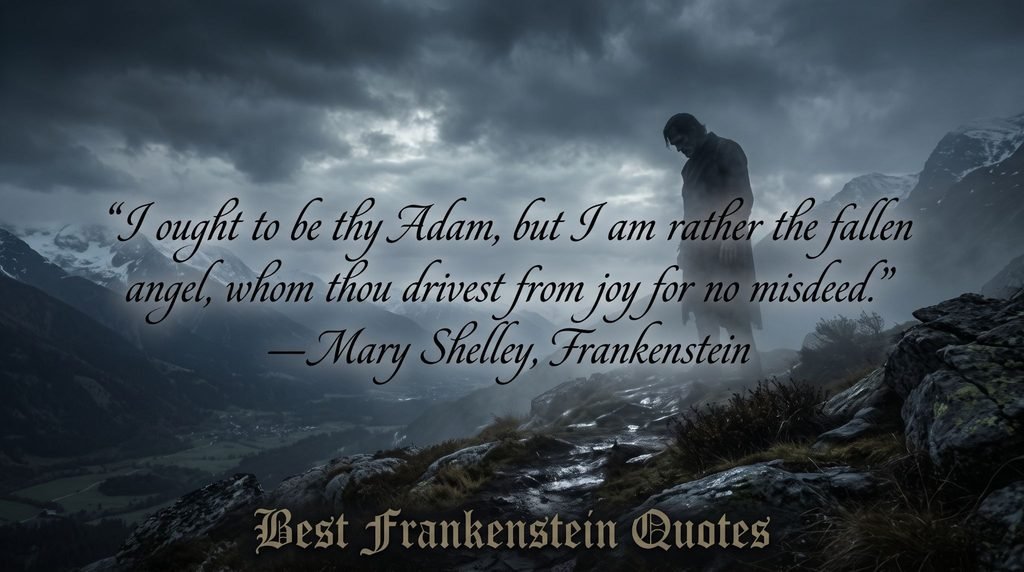
8. “I ought to be thy Adam, but I am rather the fallen angel.”
The Creature compares himself to Adam, the first human in the biblical creation story, and to a fallen angel cast away from grace. The comparison expresses his longing for acceptance and his growing bitterness.
9. “I was dependent on none, and related to none.”
The Creature describes the isolation that defines his existence. His words reveal how painful it can be to live without family, friendship, or belonging.
10. “Beware; for I am fearless, and therefore powerful.”
The Creature warns Victor that he has become dangerous. His fearlessness grows from despair and anger rather than genuine happiness.
These Frankenstein quotes about life and death remind us that scientific achievement alone cannot guarantee wisdom. Shelley asks readers to think about mortality, emotional suffering, and the consequences of treating life as an experiment. The novel’s tragedy emerges not simply from the creation of artificial life, but from the failure to care for it.
Famous Frankenstein Quotes by Mary Shelley
Mary Shelley published Frankenstein; or, The Modern Prometheus in 1818. The novel became a landmark of Gothic literature because it combines horror with questions about science, morality, and human emotion. These famous Frankenstein quotes capture Shelley’s talent for turning a frightening story into a thoughtful examination of ambition and responsibility.
1. “Beware; for I am fearless, and therefore powerful.” The Creature speaks with confidence after suffering rejection and pain. His warning shows how fearlessness can become threatening when it grows from anger.
2. “I ought to be thy Adam, but I am rather the fallen angel.” The Creature wants the care that a creator should give his creation. Instead, he feels abandoned and increasingly resembles the outcast he describes.
3. “I was benevolent and good; misery made me a fiend.” These words express the Creature’s belief that suffering changed him. Shelley invites readers to consider whether cruelty can help create the very monster people fear.
4. “Nothing is so painful to the human mind as a great and sudden change.” Victor recognizes how deeply sudden changes can affect a person. The statement reflects the novel’s repeated movement from hope to shock and despair.
5. “The world was to me a secret which I desired to divine.” Victor wants to understand nature’s hidden workings. His curiosity begins as a search for knowledge but grows into an obsession.
6. “I ardently desired the acquisition of knowledge.” The desire to learn drives Victor’s scientific journey. Shelley presents knowledge as powerful but reminds readers that the way it is pursued matters.
7. “Learn from me, if not by my precepts, at least by my example.” Victor speaks as a man who has witnessed the cost of his own choices. His warning encourages readers to examine the consequences of ambition before following it blindly.
8. “I was benevolent; my soul glowed with love and humanity.” The Creature remembers the goodness he once felt. His recollection complicates the idea that his appearance alone defines his character.
9. “The labours of men of genius, however erroneously directed, scarcely ever fail in ultimately turning to the solid advantage of mankind.” Victor reflects on scientific progress and the complicated legacy of discovery. The thought raises an important question about whether beneficial results can justify dangerous methods.
10. “I have love in me the likes of which you can scarcely imagine.” The Creature insists that his capacity for emotion is greater than others understand. His words challenge the assumption that someone frightening in appearance must also be cruel at heart.
Shelley’s most memorable lines endure because they connect Gothic horror with familiar emotions. Fear, grief, curiosity, and the desire for acceptance remain recognizable even in a story about an extraordinary scientific experiment.
Best Frankenstein Monster Quotes That Reveal His Pain
The Frankenstein monster is often remembered as a terrifying figure, but Shelley’s Creature is also intelligent, sensitive, and deeply unhappy. His suffering begins when his creator abandons him and continues as other people reject him because of his appearance. These creature quotes reveal the emotional life beneath his frightening reputation.
1. “I was benevolent and good; misery made me a fiend.” The Creature believes he began life with good intentions. His words express the damage caused by rejection and prolonged suffering.
2. “I am malicious because I am miserable.” The Creature connects his cruelty with his unhappiness. This does not excuse his actions, but it helps explain the emotional path that leads him toward revenge.
3. “I, like the arch-fiend, bore a hell within me.” The Creature describes his inner torment through a religious image. His suffering has become so intense that he feels trapped inside his own misery.
4. “I was alone.” The simple statement captures the Creature’s central struggle. Without family or companionship, he has no reliable source of comfort.
5. “No father had watched my infant days, no mother had blessed me with smiles and caresses.” The Creature describes the parental affection he never received. His words emphasize that his physical creation was not followed by the care he needed.
6. “I was dependent on none, and related to none.” The Creature recognizes his separation from ordinary human relationships. Independence offers little comfort when it comes with complete isolation.
7. “I am an unfortunate and deserted creature.” He sees himself as abandoned by the person who brought him into existence. The description emphasizes the emotional cost of Victor’s refusal to accept responsibility.
8. “I was not even of the same nature as man.” The Creature struggles to understand where he belongs. He sees himself as separated from humanity by his body and by the reactions of other people.
9. “The fallen angel becomes a malignant devil.” The Creature reflects on the transformation that follows rejection. His comparison suggests that goodness can be damaged when a person is denied compassion.
10. “I shall be with you on your wedding-night.” The Creature threatens Victor after their conflict becomes personal. His words show how grief and resentment have turned into a desire to make Victor suffer.
The Creature’s pain is central to the novel’s emotional power. Shelley does not ask readers to excuse murder or revenge. Instead, she asks them to examine how neglect, prejudice, and the absence of compassion can shape a tragic life.
Frankenstein Quotes About Creation and the Creator
Creation and responsibility form the heart of Shelley’s novel. Victor Frankenstein succeeds in bringing an artificial being to life, but he fails to prepare for the consequences of his discovery. His relationship with the Creature raises enduring questions about parenthood, scientific ethics, and the duty creators owe to what they create.
1. “A new species would bless me as its creator and source.” Victor imagines that his achievement will earn him admiration. His dream ignores the needs of the being he hopes to create.
2. “No father could claim the gratitude of his child so completely as I should deserve theirs.” Victor imagines a relationship built on gratitude. He does not yet understand that affection cannot be demanded simply because someone creates life.
3. “Life and death appeared to me ideal bounds, which I should first break through.” Victor sees mortality as a challenge to overcome. His ambition makes the limits of nature seem like obstacles rather than reasons for caution.
4. “I had desired it with an ardour that far exceeded moderation.” Victor recognizes the excessive intensity of his ambition. His experience warns against allowing a goal to overpower judgment.
5. “The accomplishment of my toils.” Victor describes the completion of his experiment in terms of labor and achievement. The phrase reveals how narrowly he has focused on the act of creation itself.
6. “The beauty of the dream vanished.” Victor’s excitement collapses when his creation becomes real. The moment exposes the difference between imagining a scientific achievement and facing its consequences.
7. “I had worked hard for nearly two years.” Victor recalls the effort he invested in his experiment. His dedication is impressive, but effort alone cannot make a decision wise or ethical.
8. “I had desired it with an ardour that far exceeded moderation.” Victor’s repeated reflection highlights the danger of unchecked ambition. He pursues his goal without giving enough thought to the welfare of his creation.
9. “I ought to be thy Adam, but I am rather the fallen angel.” The Creature judges Victor through the language of creation and abandonment. His words show that making life is only the beginning of a creator’s responsibility.
10. “Remember, that I am thy creature.” The Creature reminds Victor of their connection. He demands that his creator acknowledge the bond Victor would rather escape.
The creation-and-creator theme extends beyond the laboratory. Shelley explores what happens when power is separated from responsibility. Victor wants the glory of scientific discovery but refuses the emotional and moral duties that follow, turning a remarkable achievement into a devastating tragedy.
Frankenstein Quotes About Loneliness and Isolation
Loneliness shapes both Victor Frankenstein and his Creature. Victor isolates himself while pursuing scientific discovery, while the Creature is excluded from society because of his appearance. Their different experiences show how solitude can begin as a choice but eventually become a source of suffering.
1. “I was alone.” The Creature’s isolation is simple to describe but difficult to bear. He longs for someone who can understand him.
2. “I was dependent on none, and related to none.” The Creature has no family or social ties. His independence becomes a painful reminder of everything he lacks.
3. “No father had watched my infant days.” The Creature has never experienced parental protection. His loneliness begins at the moment his creator abandons him.
4. “I had no one to sympathise with me.” The Creature wants someone to recognize his suffering. His search for sympathy becomes a search for belonging.
5. “I was wretched, helpless, and alone.” The Creature’s experience combines emotional pain with a lack of support. His situation shows why companionship matters during difficult times.
6. “I am an unfortunate and deserted creature.” He describes himself as abandoned by the world. His words express the sadness of having no place to call home.
7. “The desert mountains and dreary glaciers are my refuge.” The Creature turns to remote landscapes for shelter. Nature offers him space when human society offers rejection.
8. “I was shut out from intercourse with them.” The Creature realizes that he cannot easily join human society. His exclusion makes ordinary social life seem like an unreachable privilege.
9. “I had never yet seen a being resembling me.” The Creature struggles with the absence of anyone like himself. His experience reflects the loneliness of feeling completely different from everyone around you.
10. “I am alone and miserable.” The Creature connects isolation with unhappiness. His words reveal that even extraordinary strength cannot replace meaningful human connection.
Shelley’s treatment of solitude and isolation is one reason the novel still resonates with modern readers. Loneliness can affect anyone, regardless of intelligence or ability. The Creature’s story also reminds us that social rejection can deepen suffering when people judge others before understanding them.
Frankenstein Quotes About Revenge, Anger, and Suffering
Revenge becomes a destructive force in Frankenstein. After repeated rejection, the Creature begins to direct his anger toward Victor, the person he believes is responsible for his misery. Victor then becomes consumed by the need to punish the Creature. Their conflict shows how hatred can trap both the victim and the person seeking revenge.
1. “I am malicious because I am miserable.” The Creature explains the connection he sees between pain and cruelty. His statement reveals his emotional reasoning without making his actions harmless.
2. “If I cannot inspire love, I will cause fear.” The Creature turns away from the acceptance he once wanted. His decision shows how disappointment can become a desire to control others through terror.
3. “Revenge remains—revenge, henceforth dearer than light or food!” The Creature gives revenge a place above ordinary needs. His words show that hatred has become the center of his existence.
4. “I will revenge my injuries; if I cannot inspire love, I will cause fear.” The Creature makes his intention clear. He chooses intimidation when he believes affection is impossible.
5. “You are my creator, but I am your master; obey!” The Creature reverses the power relationship between himself and Victor. His demand shows how the abandoned creation now seeks control over its creator.
6. “I shall be with you on your wedding-night.” The threat transforms Victor’s hope for happiness into fear. It reveals the Creature’s determination to make his creator experience personal loss.
7. “I will work at your destruction.” The Creature directs his anger toward Victor. His pursuit of revenge threatens to consume both their lives.
8. “I will glut the maw of death.” The Creature speaks in the novel’s dark, violent language. His words reflect the destructive direction of his suffering.
9. “The fallen angel becomes a malignant devil.” The Creature imagines his own transformation through a religious comparison. He sees himself becoming the very figure of evil he once feared.
10. “My reign is not yet over.” The Creature continues to think in terms of power and punishment. His determination shows how revenge can keep conflict alive long after its original cause.
The revenge theme offers no easy victory. The Creature harms innocent people, while Victor allows his hatred to consume his remaining life. Shelley suggests that revenge rarely restores what has been lost. Instead, it can multiply suffering and destroy the possibility of peace.
Frankenstein Quotes About Ambition and Obsession
Victor Frankenstein begins with a desire to understand the mysteries of life. Over time, curiosity becomes obsession, and his pursuit of knowledge separates him from family, friendship, and ordinary happiness. These passages reveal how dangerous ambition becomes when success matters more than judgment.
1. “I ardently desired the acquisition of knowledge.” Victor’s hunger for learning drives his early interests. His story asks readers to distinguish healthy curiosity from an obsession that ignores limits.
2. “The world was to me a secret which I desired to divine.” Victor wants to discover nature’s hidden truths. His curiosity becomes dangerous when he treats every boundary as something to conquer.
3. “Life and death appeared to me ideal bounds, which I should first break through.” Victor sees mortality as a challenge. His determination reveals how ambition can weaken caution.
4. “I seemed to have lost all soul or sensation but for this one pursuit.” Victor admits that his work has consumed him. His ambition leaves little room for affection or personal well-being.
5. “I had worked hard for nearly two years.” Victor remembers the time he devoted to his experiment. His effort shows persistence, but persistence without reflection can lead to disaster.
6. “The accomplishment of my toils.” Victor views the Creature as the result of his labor. His language reflects an achievement-focused mindset that overlooks the responsibilities of success.
7. “A new species would bless me as its creator and source.” Victor dreams of receiving gratitude and admiration. His ambition includes not only discovery but also the desire for glory.
8. “I had desired it with an ardour that far exceeded moderation.” Victor recognizes the intensity of his desire. The phrase captures the moment when determination crosses into dangerous obsession.
9. “Learn from me, if not by my precepts, at least by my example.” Victor presents his life as a warning. He wants others to learn from the cost of his choices.
10. “Destiny was too potent, and her immutable laws had decreed my utter and terrible destruction.” Victor reflects on the forces he believes have shaped his fate. His words also suggest how difficult it is to separate circumstances from personal responsibility.
Victor’s ambition becomes dangerous because he focuses on what he can accomplish rather than what he should do. Shelley does not condemn all scientific discovery. Instead, she questions ambition without restraint, especially when the consequences may affect other lives.
Frankenstein Quotes About Science and Dangerous Knowledge
Science is one of the most important themes in Frankenstein. Victor’s experiments challenge the boundaries of life and death, but he does not think carefully enough about the ethical consequences. Shelley’s story remains relevant wherever scientific discovery raises questions about safety, accountability, and the responsible use of knowledge.
1. “The world was to me a secret which I desired to divine.” Victor wants to uncover nature’s hidden laws. His curiosity drives him toward discoveries he is not prepared to manage.
2. “I ardently desired the acquisition of knowledge.” The pursuit of knowledge shapes Victor’s early life. Shelley shows that learning can be valuable while still requiring humility and sound judgment.
3. “Life and death appeared to me ideal bounds, which I should first break through.” Victor hopes to overcome a fundamental limit of human existence. His goal raises questions about whether every possible scientific achievement should be pursued.
4. “The raising of ghosts or devils was a promise liberally accorded by my favourite authors.” Victor recalls the strange ideas that shaped his early interests. The passage reflects the novel’s Gothic atmosphere and its fascination with the unknown.
5. “I entered with the greatest diligence into the search of the philosopher’s stone and the elixir of life.” Victor remembers his early interest in legendary scientific goals. His fascination with immortality prepares the way for his later obsession with creating life.
6. “It was the secrets of heaven and earth that I desired to learn.” Victor’s curiosity reaches beyond ordinary knowledge. His ambition becomes a search for power over mysteries that have long challenged humanity.
7. “The moon gazed on my midnight labours.” Victor’s work takes place in isolation and darkness. The image reinforces the unsettling atmosphere surrounding his scientific experiments.
8. “I had deprived myself of rest and health.” Victor recognizes the personal cost of his work. His declining well-being shows how obsession can damage the person pursuing a discovery.
9. “I pursued nature to her hiding-places.” Victor describes his relentless investigation of natural processes. The phrase reflects both scientific determination and his desire to penetrate secrets without considering the risks.
10. “Learn from me, if not by my precepts, at least by my example.” Victor turns his experience into a warning. His story encourages scientists and readers to consider consequences alongside achievement.
The novel’s treatment of dangerous knowledge is not simply an argument against science. Shelley explores the need for ethical reflection, practical responsibility, and an understanding of possible harm. A discovery may be impressive, but its value also depends on how it is used and who bears its consequences.
Frankenstein Quotes About Humanity and What Makes Us Human
The Creature looks human in some ways but is treated as less than human by nearly everyone he meets. His intelligence, emotional needs, and desire for companionship challenge the belief that appearance determines character. Shelley uses this conflict to explore humanity and identity.
1. “I was benevolent and good; misery made me a fiend.” The Creature describes a change in his character. His words challenge readers to consider how other people’s actions can influence behavior.
2. “I was benevolent; my soul glowed with love and humanity.” The Creature remembers feeling kindness and affection. His recollection suggests that humanity involves emotional capacity, not merely physical appearance.
3. “I ought to be thy Adam, but I am rather the fallen angel.” The Creature compares his experience with biblical creation. His words express his desire to be accepted rather than condemned.
4. “I am an unfortunate and deserted creature.” The Creature defines himself through abandonment. His identity has been shaped by how his creator and society treat him.
5. “I was not even of the same nature as man.” The Creature struggles to understand his difference from other people. His experience raises questions about the boundaries society draws around humanity.
6. “No Eve soothed my sorrows, nor shared my thoughts.” The Creature longs for a companion who can understand him. His wish reveals that emotional connection is central to his sense of identity.
7. “I had feelings of affection, and they were requited by detestation and scorn.” The Creature remembers offering kindness and receiving hatred. The contrast reveals the painful distance between his intentions and society’s judgment.
8. “The human senses are insurmountable barriers to our union.” The Creature recognizes that human perception prevents him from being accepted. His appearance becomes an obstacle to the relationships he wants.
9. “I was fashioned to be susceptible of love and sympathy.” The Creature understands himself as capable of affection. His tragedy lies partly in being denied the relationships that might have nurtured those qualities.
10. “If any being felt emotions of benevolence towards me, I should return them an hundred and an hundred fold.” The Creature promises extraordinary gratitude in return for kindness. His words reveal how deeply he wants a chance to participate in human relationships.
Shelley’s exploration of humanity challenges readers to look beyond appearances. The Creature commits terrible acts, but he also experiences fear, tenderness, grief, and longing. The novel asks whether people can judge another being fairly when they refuse to recognize its capacity for feeling.
Frankenstein Quotes About Love, Kindness, and Compassion
Love and compassion offer a contrast to the fear and hostility that dominate much of the novel. The Creature wants affection, Victor receives support from his family, and several characters demonstrate kindness without expecting anything in return. Yet these connections repeatedly fail to overcome the destructive force of prejudice and neglect.
1. “I was benevolent; my soul glowed with love and humanity.” The Creature recalls his original capacity for kindness. His memory suggests that compassion can exist even in someone society considers frightening.
2. “I had feelings of affection, and they were requited by detestation and scorn.” The Creature describes the rejection of his attempts at connection. His pain comes not only from loneliness but from having kindness answered with hostility.
3. “No Eve soothed my sorrows, nor shared my thoughts.” The Creature longs for a companion who can share his life. His words reveal the importance of having someone who understands your experiences.
4. “I am alone and miserable.” The Creature expresses the emotional cost of living without companionship. His statement shows that strength and independence cannot replace affection.
5. “I ought to be thy Adam, but I am rather the fallen angel.” The Creature wants a relationship built on care and acceptance. Instead, he sees himself as abandoned by the being who should have protected him.
6. “I was dependent on none, and related to none.” The Creature describes his lack of family connections. His words highlight how difficult it is to feel secure without a supportive community.
7. “My heart was fashioned to be susceptible of love and sympathy.” The Creature sees affection as part of his nature. His suffering comes partly from being denied a chance to express that nature safely.
8. “I learned to admire their virtues and to deprecate the vices of mankind.” The Creature observes a family and learns about human behavior. His developing understanding shows that empathy can grow through careful observation.
9. “The gentle manners and beauty of the cottagers greatly endeared them to me.” The Creature becomes emotionally attached to the family he watches. Their everyday kindness awakens his hope for a place among others.
10. “I longed to join them, but dared not.” The Creature wants to approach the family but fears their reaction. His hesitation captures the painful conflict between the need for connection and the fear of rejection.
Love in Frankenstein is more than romance. It includes family care, friendship, sympathy, and the willingness to recognize another being’s feelings. Shelley shows how much can be lost when fear prevents people from offering compassion.
Short Frankenstein Quotes for Instagram Captions
Short Frankenstein quotes can work well for captions about loneliness, ambition, dark moods, and being misunderstood. Mary Shelley’s novel contains memorable lines that communicate complex emotions in just a few words. If you use a quotation publicly, keep the wording faithful to your edition and credit the novel where appropriate.
1. “I was alone.” A simple caption for moments when you feel distant from the world. It captures the Creature’s loneliness in just three words.
2. “I am miserable.” This brief statement conveys emotional pain without hiding it. It suits a reflective post about difficult experiences.
3. “I was benevolent and good.” The line recalls the Creature’s belief in his original goodness. It can express the desire to be understood beyond appearances.
4. “I am thy creature.” The words emphasize the connection between Victor and the being he creates. They suit a caption about identity and responsibility.
5. “I ardently desired the acquisition of knowledge.” Victor’s words express a powerful thirst for learning. This line works for posts about curiosity and personal growth.
6. “I was dependent on none, and related to none.” The Creature describes complete independence from other people. The line reflects the complicated difference between being independent and being lonely.
7. “The world was to me a secret.” Victor sees the world as something waiting to be understood. It suits a caption about curiosity and discovery.
8. “I am an unfortunate and deserted creature.” The Creature describes the pain of abandonment. This line captures the feeling of being left behind.
9. “Beware; for I am fearless, and therefore powerful.” The Creature turns fearlessness into a warning. The line suits a dramatic Gothic caption about strength and defiance.
10. “Learn from me.” Victor attempts to turn his suffering into a lesson. This short phrase works as a reminder to learn from past mistakes.
Short Frankenstein quotes can add literary depth to social media posts. Choose lines that match the mood you want to express, whether it is thoughtful, dark, hopeful, or dramatic. For a cleaner caption, pair a brief quotation with the novel’s title or Mary Shelley’s name.
Deep Frankenstein Quotes About the Darkness Within Us
The darkness in Frankenstein comes from more than frightening appearances or mysterious experiments. It also grows from jealousy, secrecy, anger, and the desire to control others. Shelley’s Gothic literature explores the disturbing possibility that ordinary human emotions can lead to extraordinary destruction.
1. “I seemed to have lost all soul or sensation but for this one pursuit.” Victor describes the way obsession consumes him. His experience shows how a single goal can push every other responsibility aside.
2. “I was benevolent and good; misery made me a fiend.” The Creature connects his transformation to suffering. The line asks readers to examine the darkness that can develop when compassion is repeatedly denied.
3. “I, like the arch-fiend, bore a hell within me.” The Creature compares his inner torment with the suffering of a fallen angel. His darkness is emotional as well as physical.
4. “If I cannot inspire love, I will cause fear.” The Creature chooses intimidation after losing hope of acceptance. The line shows how bitterness can turn a desire for love into a desire for power.
5. “I am malicious because I am miserable.” The Creature openly links his cruelty to his misery. Shelley presents an explanation for evil without removing personal responsibility.
6. “I will work at your destruction.” The Creature makes revenge his mission. His words reveal how anger can replace every other purpose in life.
7. “The fallen angel becomes a malignant devil.” The Creature sees himself moving from suffering toward deliberate cruelty. The comparison gives his transformation a dark religious dimension.
8. “My heart was fashioned to be susceptible of love and sympathy.” The Creature recognizes the tenderness he once possessed. His suffering becomes darker because he remembers the person he wanted to be.
9. “The world was a blank to me.” The Creature begins life without knowledge or understanding. The phrase also reflects the frightening emptiness of an existence without guidance.
10. “I will glut the maw of death.” The Creature uses violent imagery to describe his destructive resolve. The line reflects the Gothic novel’s association between revenge, death, and emotional ruin.
Shelley’s darkest passages reveal that cruelty is not limited to one character. Victor’s secrecy and the Creature’s revenge both contribute to the tragedy. Their choices suggest that the darkness within people becomes most dangerous when they refuse to examine it.
Victor Frankenstein Quotes About Guilt and Regret
Victor Frankenstein’s story is shaped by regret. After bringing the Creature to life, he abandons his creation and struggles to face the consequences. As tragedy unfolds, he recognizes that his decisions have affected the lives of people he loves. His guilt makes him both a warning about unchecked ambition and a complicated portrait of human weakness.
1. “Learn from me, if not by my precepts, at least by my example.” Victor wants others to learn from his suffering. His warning reflects his regret over the path he chose.
2. “I seemed to have lost all soul or sensation but for this one pursuit.” Victor admits that obsession took control of his life. Looking back, he recognizes how much he sacrificed for his experiment.
3. “I had deprived myself of rest and health.” Victor remembers the physical price of his ambition. His exhaustion reflects the personal consequences of ignoring his well-being.
4. “The beauty of the dream vanished.” Victor’s imagined triumph disappears when he confronts the living Creature. The moment represents the collapse of his expectations.
5. “I had desired it with an ardour that far exceeded moderation.” Victor acknowledges the excessive nature of his ambition. His regret grows from understanding that he failed to exercise restraint.
6. “Nothing is so painful to the human mind as a great and sudden change.” Victor reflects on the emotional impact of unexpected events. His experience demonstrates how quickly hope can turn into distress.
7. “I, who had ever been surrounded by amiable companions, continually engaged in endeavouring to bestow mutual pleasure.” Victor remembers the warmth of his earlier life. His memories make his later isolation and guilt even more painful.
8. “I bore a hell within me.” The image of inner torment reflects the emotional burden that runs through the novel. Victor’s suffering grows as he recognizes the damage associated with his choices.
9. “Destiny was too potent, and her immutable laws had decreed my utter and terrible destruction.” Victor describes his downfall as if fate has already decided his future. His words reveal his despair, though they also raise the question of how much responsibility he is willing to accept.
10. “I have myself been blasted in these hopes, yet another may succeed.” Victor reflects on the failure of his own hopes while addressing the possibility of future achievement. His experience becomes a warning about pursuing discovery without considering its risks.
Victor’s guilt matters because he is not simply a victim of supernatural horror. He makes choices, avoids responsibility, and struggles with their results. Shelley encourages readers to consider how honest reflection might prevent a mistake from becoming a tragedy.
Frankenstein Creature Quotes About Rejection and Loneliness
The Creature’s rejection begins with Victor, who runs away from him immediately after bringing him to life. His experiences with other people reinforce the same message: his appearance makes him unwelcome. These Frankenstein creature quotes reveal the effects of social rejection and the deep desire to be accepted for who he is.
1. “I was benevolent and good; misery made me a fiend.” The Creature believes that rejection transformed him. His words show how strongly he connects his behavior with the way society treats him.
2. “I was dependent on none, and related to none.” He has no family or community to support him. His isolation makes every attempt at connection more important.
3. “I am an unfortunate and deserted creature.” The Creature describes himself as abandoned. His words capture the pain of being brought into existence without care.
4. “I had feelings of affection, and they were requited by detestation and scorn.” The Creature remembers how kindness was answered with hatred. The contrast explains why he begins to lose hope in humanity.
5. “I was not even of the same nature as man.” The Creature feels separated from ordinary human life. His sense of difference grows as other people reject him.
6. “No father had watched my infant days.” The Creature never receives the care a child normally expects. His lack of a parental bond shapes his search for guidance and acceptance.
7. “No Eve soothed my sorrows, nor shared my thoughts.” The Creature longs for a companion. His wish reflects the universal need to share feelings with someone who understands.
8. “The human senses are insurmountable barriers to our union.” The Creature recognizes that people react to his appearance before they understand his character. His body becomes a barrier to acceptance.
9. “I was alone and miserable.” The Creature summarizes the emotional result of repeated rejection. The statement shows how deeply exclusion affects his sense of self.
10. “I ought to be thy Adam, but I am rather the fallen angel.” The Creature believes that Victor should have treated him like a first child. Instead, he sees himself as an outcast who has been denied his rightful place.
Frankenstein Quotes About Good and Evil
One of the most interesting Frankenstein themes is the uncertainty surrounding good and evil. Victor looks respectable but makes selfish choices, while the Creature looks frightening yet begins with a desire for companionship. Shelley challenges readers to judge character through actions rather than appearances alone.
1. “I was benevolent and good; misery made me a fiend.” The Creature believes that suffering changed his nature. His statement asks whether cruelty can contribute to the creation of evil.
2. “I was benevolent; my soul glowed with love and humanity.” The Creature remembers his original kindness. His words challenge the assumption that a frightening appearance reveals a cruel heart.
3. “I am malicious because I am miserable.” The Creature explains the relationship between his pain and his behavior. Shelley encourages readers to understand his suffering while recognizing his responsibility for his choices.
4. “If I cannot inspire love, I will cause fear.” The Creature chooses to frighten others after losing hope of acceptance. His decision marks a movement away from kindness and toward deliberate cruelty.
5. “The fallen angel becomes a malignant devil.” The Creature describes his transformation through a religious comparison. The image captures how resentment can overwhelm a person’s original goodness.
6. “I ought to be thy Adam, but I am rather the fallen angel.” The Creature contrasts the innocence of Adam with the rejection of a fallen angel. His words reveal the conflict between his need for love and his growing bitterness.
7. “I was dependent on none, and related to none.” The Creature’s lack of social connections separates him from ordinary human relationships. His isolation makes it harder for him to develop trust.
8. “I had feelings of affection, and they were requited by detestation and scorn.” The Creature’s attempts at kindness meet with rejection. His experience illustrates how prejudice can prevent people from seeing another person’s good intentions.
9. “I will work at your destruction.” The Creature chooses revenge over reconciliation. His words show how suffering can become destructive when it is transformed into hatred.
10. “Learn from me, if not by my precepts, at least by my example.” Victor wants others to learn from his mistakes. His warning invites readers to reflect on the moral choices that lead to tragedy.
Shelley refuses to make the conflict between good and evil completely simple. Both Victor and the Creature possess admirable qualities, but both make choices that cause harm. The novel suggests that morality depends on actions, accountability, and the willingness to recognize other people’s humanity.
Frankenstein Quotes About Fear and the Unknown
Fear runs through the entire Frankenstein novel. Victor fears the consequences of his experiment, while the Creature fears rejection and hostility. Other characters react to the Creature before learning anything about his personality. These moments show how fear of the unknown can prevent understanding and encourage destructive decisions.
1. “The beauty of the dream vanished.” Victor’s excitement disappears when he sees the living result of his experiment. His reaction reveals the fear that can follow an unexpected discovery.
2. “I beheld the wretch—the miserable monster whom I had created.” Victor’s first response to his creation is horror rather than care. His reaction establishes the rejection that shapes the Creature’s life.
3. “Beware; for I am fearless, and therefore powerful.” The Creature warns Victor that he no longer fears him. His words turn the expected relationship between creator and creation upside down.
4. “I was seized by remorse and the sense of guilt.” Victor experiences the emotional consequences of his actions. His fear is no longer simply about the unknown but about the harm that may follow his choices.
5. “I pursued nature to her hiding-places.” Victor describes his relentless search for scientific secrets. The phrase conveys both curiosity and the unsettling desire to penetrate the unknown.
6. “The world was to me a secret which I desired to divine.” Victor sees nature as a mystery waiting to be solved. His curiosity becomes a source of danger when he ignores the limits of his understanding.
7. “I, like the arch-fiend, bore a hell within me.” The Creature describes his inner torment. His fear and suffering become part of the darkness that shapes his later actions.
8. “I am malicious because I am miserable.” The Creature admits that misery influences his behavior. His words show how fear, rejection, and anger can combine to create hostility.
9. “I will work at your destruction.” The Creature’s threat gives Victor a new reason to fear him. The conflict between them becomes a cycle of anticipation, dread, and revenge.
10. “I shall be with you on your wedding-night.” The Creature uses uncertainty to frighten Victor. His threat turns a moment of expected happiness into a source of dread.
Fear is powerful in Shelley’s novel because characters often act before they understand what they face. The Creature is feared because of his appearance, and Victor fears the consequences of his own creation. Their reactions show how fear can prevent thoughtful decisions and deepen conflict.
Frankenstein Quotes About Nature and the Sublime
Nature plays an important role in Frankenstein. Mountains, glaciers, forests, and vast landscapes give characters moments of reflection when ordinary life becomes unbearable. Shelley uses the sublime—the mixture of awe, beauty, and fear inspired by something greater than oneself—to contrast the natural world with Victor’s artificial creation.
1. “The immense mountains and precipices that overhung me on every side.” Victor describes a landscape that makes him feel small. The scene reflects the power of nature to overwhelm human ambition.
2. “The sea, or rather the vast river of ice, wound among its dependent mountains.” The landscape appears immense and almost alive. Its scale offers a striking contrast to the narrow world of Victor’s laboratory.
3. “These sublime and magnificent scenes afforded me the greatest consolation.” Victor finds temporary comfort in the natural world. Nature provides relief from the guilt and grief that follow his experiment.
4. “The sight of the awful and majestic in nature had indeed always the effect of solemnizing my mind.” Victor explains how grand landscapes affect his thoughts. Nature encourages reflection and temporarily quiets his emotional turmoil.
5. “I contemplated the lake: the waters were placid.” The quiet landscape creates a moment of stillness. Its calmness contrasts with the emotional conflict unfolding in Victor’s life.
6. “The sea, or rather the vast river of ice.” The image emphasizes the scale and strangeness of the natural world. It reflects the novel’s fascination with forces that humans cannot easily control.
7. “The rain pattered dismally against the panes.” The gloomy weather reinforces the story’s Gothic atmosphere. The natural setting mirrors the sadness and dread surrounding the characters.
8. “The cold stars shone in mockery.” The night sky seems indifferent to human suffering. The image emphasizes the loneliness of characters who feel abandoned by the world.
9. “The desert mountains and dreary glaciers are my refuge.” The Creature finds shelter in remote natural places. Nature offers space to someone who cannot find acceptance among people.
10. “The moon gazed on my midnight labours.” Victor remembers working through the night. The image connects his scientific obsession with darkness and isolation.
Nature in Frankenstein is not merely scenery. It provides emotional relief, creates fear, and reminds characters of forces larger than themselves. Shelley contrasts the beauty of the natural world with the consequences of Victor’s attempt to control life through artificial means.
Frankenstein Quotes About Friendship and Companionship
Friendship gives many characters in Frankenstein a sense of comfort and belonging. Henry Clerval supports Victor during difficult periods, while the Creature watches a family and hopes to become part of their lives. These relationships reveal what the Creature lacks and what Victor risks losing when he isolates himself.
1. “I have no friend, Margaret.” Robert Walton expresses his longing for someone who can understand his ambitions. His loneliness creates a parallel with the Creature’s search for companionship.
2. “I desire the company of a man who could sympathise with me.” Walton wants a friend who shares his thoughts and feelings. His wish reflects the human need for emotional understanding.
3. “I have one want which I have never yet been able to satisfy.” Walton explains that achievement cannot meet every need. His desire for companionship remains even as he pursues exploration.
4. “I had rather be with you than any one else.” Victor’s relationships with loved ones reveal his need for connection. The sentiment contrasts with the isolation he chooses during his experiments.
5. “The gentle manners and beauty of the cottagers greatly endeared them to me.” The Creature becomes attached to a family he observes from a distance. Their kindness inspires his hope for friendship.
6. “I longed to join them, but dared not.” The Creature wants to approach the family but fears their reaction. His hesitation reveals the conflict between hope and fear.
7. “I learned to admire their virtues and to deprecate the vices of mankind.” The Creature develops an understanding of human behavior by watching others. His observations show how companionship can teach values even before a relationship begins.
8. “No Eve soothed my sorrows, nor shared my thoughts.” The Creature wishes for someone who can share his life. His loneliness reveals that companionship means more than simply having another person nearby.
9. “I had feelings of affection, and they were requited by detestation and scorn.” The Creature’s attempts at connection end in rejection. His experience demonstrates the harm caused when people refuse to look beyond appearances.
10. “I am alone and miserable.” The Creature summarizes the cost of living without companionship. His statement contrasts with the comfort that Victor and Walton seek from their relationships.
Friendship is a quiet but important theme in Frankenstein. Walton’s letters, Victor’s memories of Clerval, and the Creature’s longing for the cottagers all show that human connection can provide emotional strength. The novel also warns that isolation can leave people more vulnerable to obsession, despair, and destructive choices.
Frankenstein Quotes About Fate and Free Will
Victor often describes his downfall as if fate has determined everything that happens to him. Yet his story also contains many personal decisions: he pursues his experiment, abandons his creation, and struggles to confront the consequences. Shelley leaves readers to consider the relationship between circumstances, destiny, and individual responsibility.
1. “Destiny was too potent, and her immutable laws had decreed my utter and terrible destruction.” Victor believes his downfall is inevitable. His words reveal how despair can make a person feel powerless over the future.
2. “Learn from me, if not by my precepts, at least by my example.” Victor presents his life as a warning. His advice suggests that choices can teach lessons even when their consequences cannot be undone.
3. “I ardently desired the acquisition of knowledge.” Victor’s curiosity shapes his path. The line reminds readers that personal desires can influence the direction of a life.
4. “I seemed to have lost all soul or sensation but for this one pursuit.” Victor describes how obsession narrowed his choices. His experience suggests that freedom can be weakened when a person allows one goal to control everything.
5. “I had desired it with an ardour that far exceeded moderation.” Victor acknowledges the intensity of his ambition. His regret implies that he might have acted differently if he had exercised restraint.
6. “Life and death appeared to me ideal bounds, which I should first break through.” Victor chooses to challenge the limits of mortality. His ambition becomes the starting point of the tragedy.
7. “I was benevolent and good; misery made me a fiend.” The Creature connects his transformation with painful experiences. His claim raises questions about the balance between personal choices and outside influences.
8. “If I cannot inspire love, I will cause fear.” The Creature makes a deliberate decision to pursue revenge. His suffering helps explain his anger, but his choice still contributes to the tragedy.
9. “I will work at your destruction.” The Creature commits himself to a destructive purpose. The line shows how a person can become trapped by decisions made in anger.
10. “I shall be with you on your wedding-night.” The Creature chooses to threaten Victor at a moment of anticipated happiness. His actions show how the pursuit of revenge can shape the future of both people.
Fate and free will remain intertwined throughout Frankenstein. Victor believes that destiny controls his destruction, but his choices help create the conditions for it. Shelley encourages readers to recognize the influence of circumstances without ignoring the power and consequences of personal decisions.
Frankenstein Quotes About Responsibility and Consequences
Victor’s greatest mistake may not be the creation of life itself, but his refusal to care for what he creates. He wants to achieve something extraordinary without accepting the duties that follow. This theme makes Frankenstein a powerful story about moral responsibility and the consequences of scientific discovery.
1. “Remember, that I am thy creature.” The Creature reminds Victor of their connection. His words demand recognition from the person who brought him into the world.
2. “You are my creator, but I am your master; obey!” The Creature reverses their relationship. His demand shows how Victor’s refusal to accept responsibility has allowed their conflict to grow.
3. “A new species would bless me as its creator and source.” Victor imagines the rewards of his achievement. He fails to consider how much care and guidance a new life might require.
4. “No father could claim the gratitude of his child so completely as I should deserve theirs.” Victor expects gratitude from the beings he hopes to create. His thinking reveals how he confuses creating life with earning affection.
5. “Life and death appeared to me ideal bounds, which I should first break through.” Victor treats mortality as a scientific challenge. His determination overlooks the ethical questions that should accompany such a powerful undertaking.
6. “I had desired it with an ardour that far exceeded moderation.” Victor recognizes that his ambition went too far. His reflection shows the importance of restraint before acting on a powerful desire.
7. “Learn from me, if not by my precepts, at least by my example.” Victor wants others to learn from his failures. His warning emphasizes that actions can have consequences far beyond what someone initially expects.
8. “I was benevolent and good; misery made me a fiend.” The Creature argues that neglect contributed to his transformation. His words raise questions about the responsibility people have toward those who depend on them.
9. “I am malicious because I am miserable.” The Creature explains his cruelty through his emotional suffering. His explanation encourages empathy, while the harm he causes reminds readers that suffering does not erase accountability.
10. “I shall be with you on your wedding-night.” The Creature threatens Victor in a deeply personal way. His threat reveals the terrible consequences of a conflict neither character successfully resolves.
The novel’s lesson about responsibility applies far beyond Victor’s laboratory. Parents, leaders, scientists, and inventors all need to consider the effects of their actions. Shelley reminds us that an achievement becomes dangerous when its creator refuses to think about the lives it may change.
Sad Frankenstein Quotes That Reveal the Creature’s Sorrow
The Creature’s sadness comes from more than his unusual appearance. He is abandoned by Victor, denied companionship, and repeatedly treated as a threat. His sorrow makes him one of the novel’s most tragic characters, even as his later violence complicates our sympathy for him.
1. “I am an unfortunate and deserted creature.” The Creature sees himself as abandoned by his creator. His words capture the sadness of having no secure place in the world.
2. “I was alone.” The simplicity of the statement emphasizes his isolation. It reveals how little comfort he has in a world full of people.
3. “I am alone and miserable.” The Creature connects his loneliness with emotional suffering. His words show that isolation is not simply the absence of company but the absence of meaningful connection.
4. “No father had watched my infant days.” The Creature never experiences the care of a parent. His sadness is rooted in the absence of guidance from the beginning of his life.
5. “No Eve soothed my sorrows, nor shared my thoughts.” The Creature longs for someone who can understand him. His wish reveals how painful it is to face every difficulty alone.
6. “I had feelings of affection, and they were requited by detestation and scorn.” The Creature remembers offering kindness and receiving hatred. The contrast deepens his sense of injustice.
7. “I was benevolent; my soul glowed with love and humanity.” He recalls a time when he felt capable of goodness. His memory makes his later misery more heartbreaking.
8. “The world was a blank to me.” The Creature describes his early confusion. The line also suggests the emptiness of a life without knowledge, guidance, or companionship.
9. “I had no one to sympathise with me.” The Creature wants another being to understand his suffering. His need for sympathy is central to his emotional tragedy.
10. “I was dependent on none, and related to none.” The Creature has no family or lasting bonds. His independence becomes another expression of the loneliness he cannot escape.
The Creature’s sorrow helps explain why readers continue to debate his character. He is neither an innocent victim in every situation nor a simple embodiment of evil. Shelley presents a being who wants love but responds to suffering with choices that bring even more pain.
Powerful Frankenstein Quotes About Human Cruelty
Human cruelty is one of the forces that shapes the Creature’s transformation. People react to his appearance with fear, violence, and disgust before learning who he is. Shelley uses these encounters to question how society treats those who look or behave differently.
1. “I was benevolent and good; misery made me a fiend.” The Creature believes cruelty changed his nature. His statement invites readers to consider how mistreatment can contribute to destructive behavior.
2. “I had feelings of affection, and they were requited by detestation and scorn.” The Creature’s kindness receives hatred in return. His experience shows how prejudice can destroy the possibility of trust.
3. “I was not even of the same nature as man.” The Creature feels excluded from humanity. The rejection he experiences makes him question whether society will ever accept him.
4. “I am an unfortunate and deserted creature.” The Creature describes the abandonment at the center of his life. His words point to the harm caused when people refuse to care for someone vulnerable.
5. “I was benevolent; my soul glowed with love and humanity.” The Creature remembers his original goodwill. His recollection contrasts with the hostile treatment that follows.
6. “If I cannot inspire love, I will cause fear.” The Creature turns toward intimidation after losing hope. His choice demonstrates how cruelty can spread when pain becomes a reason to hurt others.
7. “I am malicious because I am miserable.” The Creature explains his destructive behavior. His reasoning reveals the connection between suffering and anger, though it does not excuse his violence.
8. “The fallen angel becomes a malignant devil.” The Creature imagines his transformation into an evil figure. The comparison reflects how repeated rejection has shaped his identity.
9. “I ought to be thy Adam, but I am rather the fallen angel.” The Creature believes his creator should have offered care. His words express the injustice he feels after being abandoned.
10. “I will work at your destruction.” The Creature directs his anger toward Victor. His threat shows how the cycle of cruelty eventually harms both the person who inflicts suffering and the person who receives it.
Shelley’s portrayal of cruelty encourages readers to question their first impressions. The Creature’s appearance makes others afraid, but their reactions often prevent them from recognizing his feelings. At the same time, the Creature’s later violence demonstrates that people who suffer can also become responsible for harming others.
Frankenstein Quotes About Prejudice and Judging Others
Appearance strongly influences how the Creature is treated. People judge him before discovering his intelligence, kindness, or emotional needs. Through these experiences, Shelley examines prejudice and the social rejection that occurs when people mistake difference for danger.
1. “I was benevolent; my soul glowed with love and humanity.” The Creature remembers his desire to be kind. His words challenge the assumption that his frightening appearance reflects his inner character.
2. “I had feelings of affection, and they were requited by detestation and scorn.” The Creature’s goodwill is met with rejection. His experience illustrates how prejudice can prevent a fair judgment of another being.
3. “I was not even of the same nature as man.” The Creature feels excluded from human society. His sense of difference grows as others refuse to accept him.
4. “The human senses are insurmountable barriers to our union.” The Creature recognizes the role of appearance in his rejection. His words reveal how physical impressions can stand in the way of emotional understanding.
5. “I am an unfortunate and deserted creature.” The Creature describes himself as an outcast. His identity has been shaped by other people’s unwillingness to look beyond his appearance.
6. “I ought to be thy Adam, but I am rather the fallen angel.” The Creature contrasts the care he hoped to receive with the rejection he experiences. The comparison expresses his feeling that he has been denied a fair chance at life.
7. “No father had watched my infant days.” The Creature’s lack of parental care leaves him without protection. His story reveals how vulnerable a rejected being can become without guidance.
8. “I was alone.” The Creature’s isolation is the direct result of his inability to find acceptance. The short statement captures the emotional consequence of being treated as an outsider.
9. “I am malicious because I am miserable.” The Creature links his misery to his behavior. His statement encourages readers to examine how prejudice and exclusion can contribute to conflict.
10. “If I cannot inspire love, I will cause fear.” The Creature responds to rejection by choosing intimidation. The line shows the danger of allowing prejudice and pain to develop into hatred.
The prejudice in Frankenstein is not limited to appearance. It also concerns the willingness to listen, understand, and treat another being fairly. Shelley encourages readers to look beyond first impressions while recognizing that empathy must be accompanied by honest judgment of actions.
Iconic Frankenstein Book Quotes Every Reader Should Know
Some lines from Frankenstein have become famous because they express the novel’s central conflicts so clearly. They capture Victor’s ambition, the Creature’s suffering, and the moral questions that make Mary Shelley’s work important. These iconic Frankenstein book quotes are especially useful for readers studying the novel or looking for memorable passages.
1. “Learn from me, if not by my precepts, at least by my example.” Victor offers his experience as a warning. His words encourage readers to learn from mistakes rather than repeat them.
2. “I ought to be thy Adam, but I am rather the fallen angel.” The Creature compares his experience with biblical creation. His words reveal his longing for acceptance and his anger at being abandoned.
3. “I was benevolent and good; misery made me a fiend.” The Creature explains how he believes suffering changed him. This line captures one of the novel’s central questions about human nature.
4. “Beware; for I am fearless, and therefore powerful.” The Creature warns Victor that he has become dangerous. The statement shows how fearlessness can become threatening when it grows from anger.
5. “I ardently desired the acquisition of knowledge.” Victor explains the curiosity that drives his life. The line reflects the novel’s interest in learning and the risks of pursuing it without restraint.
6. “Life and death appeared to me ideal bounds, which I should first break through.” Victor describes his desire to overcome mortality. The quotation captures his ambition to control a fundamental part of existence.
7. “The world was to me a secret which I desired to divine.” Victor sees nature as a mystery waiting to be understood. His curiosity eventually leads him into dangerous territory.
8. “I am an unfortunate and deserted creature.” The Creature describes his abandoned state. The line conveys his longing for a place where he can belong.
9. “Nothing is so painful to the human mind as a great and sudden change.” Victor reflects on the effect of unexpected events. His observation remains relatable because change can challenge even the most confident person.
10. “I am malicious because I am miserable.” The Creature explains his own destructive behavior. The statement captures the connection between suffering, anger, and personal responsibility.
These iconic passages reveal why Shelley’s novel remains relevant. They offer powerful starting points for literary analysis because each one connects a character’s personal experience with a larger question about society, morality, or human nature.
Frankenstein Quotes About Being an Outsider
The Creature is an outsider from the moment he enters the world. He has no family, no community, and no one who can explain his existence to him. His experiences reflect the pain of being different and the desire to find a place where one can belong.
1. “I was alone.” The Creature’s short statement expresses his isolation. It reflects the feeling of being surrounded by a world that offers no companionship.
2. “I am an unfortunate and deserted creature.” The Creature describes himself as abandoned. His words reveal how strongly rejection shapes his identity.
3. “I was dependent on none, and related to none.” The Creature has no family connections. His independence is inseparable from the loneliness he experiences.
4. “I was not even of the same nature as man.” The Creature feels separated from humanity. His difference becomes more painful when other people treat it as a reason for exclusion.
5. “No Eve soothed my sorrows, nor shared my thoughts.” The Creature longs for someone like himself. His wish reflects the desire to be understood without having to explain every part of his experience.
6. “I had no one to sympathise with me.” The Creature wants someone to recognize his pain. His isolation deepens because no one offers the understanding he seeks.
7. “I had feelings of affection, and they were requited by detestation and scorn.” The Creature’s kindness receives hostility. His experience shows how difficult it can be to remain hopeful when others refuse to accept you.
8. “The human senses are insurmountable barriers to our union.” The Creature recognizes that his appearance prevents acceptance. His words express the frustration of being judged before being known.
9. “I was benevolent; my soul glowed with love and humanity.” The Creature remembers the goodness he once felt. His words challenge the idea that outsiders are necessarily dangerous.
10. “If I cannot inspire love, I will cause fear.” The Creature responds to exclusion by choosing intimidation. His decision reveals the destructive potential of unresolved pain.
The outsider theme is one reason readers continue to identify with the Creature. His experiences raise questions about belonging, identity, and prejudice. Shelley also shows that feeling rejected does not make harmful actions inevitable; the Creature’s choices remain an important part of the tragedy.
Frankenstein Quotes About Revenge and the Desire for Justice
The Creature initially wants sympathy and companionship, but repeated rejection changes his goals. He begins to see revenge as a way to answer the injustice he believes he has suffered. Shelley explores the difference between wanting fair treatment and seeking to make another person suffer.
1. “I am malicious because I am miserable.” The Creature explains how suffering influences his behavior. His words reveal the emotional background to his desire for revenge.
2. “If I cannot inspire love, I will cause fear.” The Creature abandons the hope of acceptance. His decision replaces a search for justice with an attempt to control others through terror.
3. “I will work at your destruction.” The Creature directs his anger toward Victor. His words reveal how completely revenge has taken over his purpose.
4. “You are my creator, but I am your master; obey!” The Creature demands control over Victor. Their relationship has become a struggle for power rather than an opportunity for understanding.
5. “I shall be with you on your wedding-night.” The Creature threatens Victor’s happiness. The line shows how his revenge reaches beyond the original conflict and threatens innocent people.
6. “I ought to be thy Adam, but I am rather the fallen angel.” The Creature believes he has been denied the care he deserved. His sense of injustice fuels his resentment.
7. “I was benevolent and good; misery made me a fiend.” The Creature presents his suffering as the cause of his transformation. His explanation helps readers understand his anger without justifying his violence.
8. “I was dependent on none, and related to none.” The Creature’s lack of social bonds intensifies his isolation. Without support, he becomes increasingly focused on the person he blames.
9. “I, like the arch-fiend, bore a hell within me.” The Creature describes his inner torment. His misery becomes a constant source of anger and destructive thoughts.
10. “Learn from me, if not by my precepts, at least by my example.” Victor’s warning offers a different perspective on revenge. His life demonstrates how the desire to destroy an enemy can also destroy the person seeking vengeance.
Shelley shows that injustice can produce genuine suffering, but revenge does not necessarily repair it. The Creature’s desire for justice becomes destructive because he increasingly seeks punishment instead of a way to live without hatred. The novel asks readers to distinguish accountability from retaliation.
Thought-Provoking Frankenstein Quotes About Existence
Questions about existence run throughout Frankenstein. Victor wants to discover how life begins, while the Creature struggles to understand why he exists and what purpose his life might serve. Their experiences turn the Gothic story into a philosophical exploration of identity, mortality, and the search for meaning.
1. “Life and death appeared to me ideal bounds, which I should first break through.” Victor treats existence as a mystery that science might overcome. His ambition raises questions about the limits people should respect.
2. “The world was to me a secret which I desired to divine.” Victor wants to understand the nature of reality. His curiosity reflects the human desire to find answers to difficult questions.
3. “I ardently desired the acquisition of knowledge.” Victor’s search for understanding shapes his life. The line invites readers to think about what knowledge can offer and what it cannot replace.
4. “I was alone.” The Creature confronts existence without companionship. His isolation raises questions about whether life can feel complete without meaningful relationships.
5. “I am an unfortunate and deserted creature.” The Creature struggles to define himself in a world that rejects him. His existence becomes inseparable from his search for belonging.
6. “I ought to be thy Adam, but I am rather the fallen angel.” The Creature compares his life with biblical accounts of creation. His words reveal his desire to understand why he has been denied acceptance.
7. “I was benevolent and good; misery made me a fiend.” The Creature considers how experience has shaped his identity. His statement asks whether a person’s nature is fixed or can be changed by suffering.
8. “Nothing is so painful to the human mind as a great and sudden change.” Victor reflects on how quickly life can become unfamiliar. His observation captures the difficulty of adapting to unexpected events.
9. “I had feelings of affection, and they were requited by detestation and scorn.” The Creature describes the painful gap between his feelings and others’ reactions. His experience raises questions about the role of society in shaping a person’s sense of self.
10. “Learn from me, if not by my precepts, at least by my example.” Victor tries to make his life meaningful by turning it into a warning. His words suggest that reflection can help others find wisdom in another person’s mistakes.
Frankenstein remains thought-provoking because it offers no easy answers about existence. The Creature wants to understand his identity, Victor wants to master life, and both struggle with the consequences. Their stories remind readers that meaning comes not only from knowledge but also from responsibility and connection.
Dark Frankenstein Quotes About Monsters and Humanity
The word monster carries much of the novel’s emotional weight. Victor uses it to describe the being he creates, while the Creature gradually begins to see himself through the judgment of others. Shelley complicates the idea of monstrosity by showing that cruelty, neglect, and revenge can be just as frightening as an unusual appearance.
1. “I was benevolent and good; misery made me a fiend.” The Creature believes that suffering changed his character. His words challenge readers to look beyond appearance when deciding who deserves compassion.
2. “I am malicious because I am miserable.” The Creature links his cruelty to his unhappiness. His explanation reveals his pain, but it also exposes how he uses that pain to justify harmful behavior.
3. “I, like the arch-fiend, bore a hell within me.” The Creature describes his emotional torment through a dark religious image. His suffering becomes a private prison that shapes his view of the world.Read other article Good Morning Blessings Quotes
4. “The fallen angel becomes a malignant devil.” The Creature imagines himself changing into a figure of evil. His comparison reveals how strongly he believes that rejection has transformed him.
5. “If I cannot inspire love, I will cause fear.” The Creature decides to replace his hope for acceptance with intimidation. His choice marks a disturbing shift from longing for kindness to deliberately creating suffering.
6. “I will work at your destruction.” The Creature makes revenge his purpose. The threat shows how anger has replaced his earlier desire for companionship.
7. “Beware; for I am fearless, and therefore powerful.” The Creature warns Victor that he is no longer intimidated by him. The statement makes the rejected creation seem more powerful than the person who brought him to life.
8. “I ought to be thy Adam, but I am rather the fallen angel.” The Creature compares himself with figures from biblical tradition. He believes he has been denied the care and belonging that should have accompanied his creation.
9. “The beauty of the dream vanished.” Victor’s dream of achievement disappears when he confronts the reality of his experiment. The moment reveals the darkness behind his ambition.
10. “Learn from me, if not by my precepts, at least by my example.” Victor turns his suffering into a warning. His words suggest that the real horror of his story lies in the consequences of choices, not simply in the existence of a monster.
The dark atmosphere of Frankenstein comes from the characters’ inner struggles as much as its frightening events. Shelley asks readers to consider whether society can help create the monsters it fears. She also shows that understanding a character’s suffering does not require approving of the harm that character causes.
Inspirational Frankenstein Quotes About Life Lessons
Although Frankenstein is a tragic Gothic novel, it contains important lessons about learning, empathy, responsibility, and self-reflection. Victor’s mistakes warn against unchecked ambition, while the Creature’s experiences demonstrate the importance of kindness and belonging. These passages can inspire thoughtful reflection without ignoring the tragedy behind them.
1. “Learn from me, if not by my precepts, at least by my example.” Victor encourages others to learn from his mistakes. His words remind readers that reflection can prevent past failures from being repeated.
2. “I ardently desired the acquisition of knowledge.” Victor’s curiosity reflects the human desire to learn. His story also reminds us to balance ambition with wisdom and ethical judgment.
3. “The world was to me a secret which I desired to divine.” Victor approaches life with curiosity. The line encourages exploration while reminding readers that understanding requires patience and responsibility.
4. “I had rather be with you than any one else.” The novel’s relationships show the value of emotional connection. The sentiment reminds readers that the people who support us can matter more than personal achievement.
5. “I have one want which I have never yet been able to satisfy.” Walton recognizes that exploration cannot fulfill every need. His longing for friendship illustrates why success alone may not bring happiness.
6. “I was benevolent; my soul glowed with love and humanity.” The Creature remembers his capacity for kindness. His words encourage readers to recognize the value of compassion, even in difficult circumstances.
7. “I learned to admire their virtues and to deprecate the vices of mankind.” The Creature develops his understanding by observing others. His experience shows that learning about people requires attention and reflection.
8. “Nothing is so painful to the human mind as a great and sudden change.” Victor recognizes the difficulty of adapting to unexpected events. The line encourages patience with ourselves and others during periods of change.
9. “I was benevolent and good; misery made me a fiend.” The Creature’s words warn about the consequences of prolonged suffering. They encourage readers to respond to distress with care while remembering the importance of personal responsibility.
10. “I shall die, and what I now feel be no longer felt.” The Creature reflects on the end of his suffering. His words invite readers to consider mortality and the importance of how we live before life ends.
The most useful lessons from Frankenstein are not simple motivational slogans. They emerge from the characters’ failures and painful experiences. Shelley encourages readers to pursue knowledge thoughtfully, treat others with compassion, and accept responsibility for the effects of their actions.
Best Frankenstein Quotes That Still Haunt Readers Today
More than two centuries after its publication, Frankenstein continues to unsettle readers because its central questions remain unresolved. Can a creator escape responsibility for a creation? Does suffering explain cruelty? Can scientific progress become dangerous when ethical judgment is ignored? These memorable Frankenstein quotes bring those questions into focus.
1. “I ought to be thy Adam, but I am rather the fallen angel.” The Creature expresses the painful gap between the care he expected and the rejection he received. His words remain haunting because they capture the desire to belong and the bitterness of being excluded.
2. “I was benevolent and good; misery made me a fiend.” The Creature describes his transformation in a single powerful statement. It forces readers to consider how suffering can influence character without removing personal responsibility.
3. “Beware; for I am fearless, and therefore powerful.” The Creature warns Victor that he has become dangerous. The line is chilling because it reveals how far their relationship has moved from creator and creation to enemies.
4. “Life and death appeared to me ideal bounds, which I should first break through.” Victor’s ambition begins with a desire to overcome mortality. His words remain relevant in discussions about the limits and responsibilities of scientific discovery.
5. “The world was to me a secret which I desired to divine.” Victor’s curiosity drives him toward the unknown. The line captures both the excitement of discovery and the danger of pursuing knowledge without caution.
6. “I am malicious because I am miserable.” The Creature offers his suffering as an explanation for his actions. The statement is haunting because it shows how pain can become a justification for cruelty.
7. “If I cannot inspire love, I will cause fear.” The Creature abandons the hope of being accepted. His words reveal the tragic moment when the desire for love turns into a determination to frighten others.
8. “I will work at your destruction.” The Creature makes revenge his mission. The threat captures the destructive cycle that consumes both him and Victor.
9. “Nothing is so painful to the human mind as a great and sudden change.” Victor reflects on the shock of unexpected events. The line remains relatable because life can change in ways that challenge our sense of control.
10. “Learn from me, if not by my precepts, at least by my example.” Victor’s warning gives the novel a lasting moral force. His experience reminds readers that ambition must be balanced with care, judgment, and responsibility.
The best Frankenstein quotes continue to haunt readers because they are about more than monsters. They explore familiar fears: being rejected, losing control, making irreversible mistakes, and discovering too late that achievement cannot replace compassion. Shelley’s novel remains powerful because its questions are still relevant to human life.
Frequently Asked Questions
What are the Best Frankenstein Quotes from Mary Shelley?
The best Frankenstein quotes explore ambition, loneliness, revenge, and human nature. They reveal the struggles of Victor Frankenstein and his tragic Creature.
Why are Best Frankenstein Quotes still popular today?
These quotes explore timeless themes like rejection, identity, and responsibility. Their lessons remain meaningful for modern readers and literature lovers.
What are the Best Frankenstein Quotes about loneliness?
The Creature’s words express deep sadness and isolation. They show his desire for friendship, love, and acceptance in a world that rejects him.
Which Best Frankenstein Quotes describe Victor Frankenstein’s ambition?
Victor’s quotes reveal his desire to discover the secrets of life. They warn readers about obsession and the consequences of unchecked ambition.
Where can I use Best Frankenstein Quotes?
You can use these quotes for Instagram captions, literary essays, book reviews, and classroom discussions. Always check the original text for accurate wording.
Conclusion
The Best Frankenstein Quotes remind us that every action has consequences. Mary Shelley’s story teaches important lessons about ambition, loneliness, and human nature. Victor Frankenstein wants to gain knowledge and create life. However, he fails to understand his responsibility. His choices bring pain to himself and others. The creature also shows how rejection and loneliness can change a person. These powerful words encourage readers to think about kindness, acceptance, and the true meaning of humanity.
We hope these quotes helped you understand the deeper message of Frankenstein. The story still matters because its themes connect with real life. The Best Frankenstein Quotes offer valuable lessons about love, loss, revenge, and responsibility. Frankenstein ambition quotes also show why chasing success without thinking about the consequences can lead to tragedy. Take time to reflect on these memorable words. Share your favorite quotes with friends and keep the lessons of this classic novel close to your heart.

QuotesWhisper is a welcoming destination for inspiring quotes, meaningful messages, and uplifting words, managed by Ethan Parker, an SEO content writer with 2 years of experience, focused on creating simple, thoughtful, and engaging content that helps readers find the right words for every feeling and occasion.
1 thought on “150+ Best Frankenstein Quotes That Reveal the Dark Side of Humanity (2026)”