
John Locke was a famous philosopher who shared powerful ideas about freedom, knowledge, and human rights. His words still inspire people around the world. These Best John Locke Quotes offer simple lessons about life, truth, and personal growth. They help us understand the value of freedom and the importance of fair government. His thoughts also remind us to think clearly and make wise choices. Whether you love philosophy or seek daily inspiration, his words have something meaningful to teach.
In this collection, you will find quotes about liberty, education, wisdom, and human nature. Each quote shares an idea that can help you see life from a new perspective. You can also explore john locke quotes on education to learn about his views on learning and character. These Best John Locke Quotes are perfect for students, teachers, and anyone who enjoys deep thoughts in simple words. Read them and discover timeless wisdom.
Best John Locke Quotes of All Time
John Locke’s most memorable ideas concern freedom, equality, knowledge, property, and political authority. His writings challenge readers to question absolute power and consider how people can live together under fair laws.
- “Being all equal and independent, no one ought to harm another in his life, health, liberty, or possessions.” — Second Treatise of Government, §6.
- “Where there is no law, there is no freedom.” — Second Treatise of Government, §57.
- “Every man has a property in his own person.” — Second Treatise of Government, §27.
- “No man’s knowledge here can go beyond his experience.” — An Essay Concerning Human Understanding, Book II, Chapter I.
- “The great and chief end, therefore, of men’s uniting into commonwealths, and putting themselves under government, is the preservation of their property.” — Second Treatise of Government, §124.
- Locke’s idea: Every person deserves respect because human beings are naturally equal and independent.
- Locke’s idea: Government should protect people’s rights instead of treating citizens as possessions of the state.
- Locke’s idea: Knowledge develops through experience rather than being fully formed in the mind from birth.
- Locke’s idea: Political authority requires justification and cannot legitimately depend on unlimited personal power.
- Locke’s idea: A just society balances individual liberty with responsibilities toward other people.
These ideas explain why Locke remains important in discussions about democracy, constitutional government, human rights, and modern education.
John Locke Quotes on Liberty and Freedom
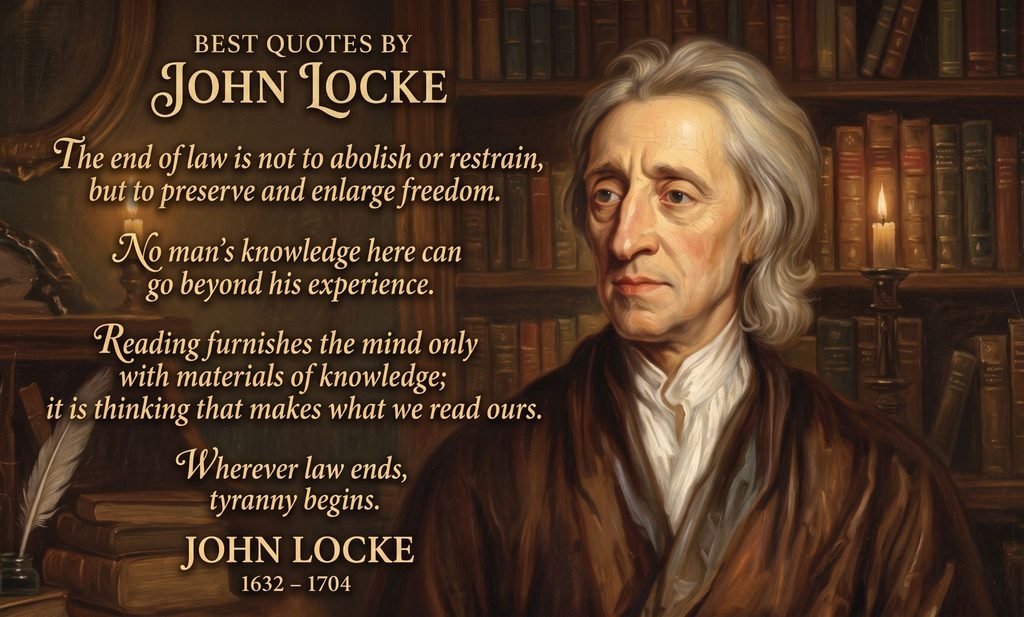
Liberty was central to Locke’s political philosophy. He argued that people should be free to direct their lives within the boundaries of natural law and the equal rights of others. For Locke, freedom did not mean having unlimited permission to do anything; it meant living without arbitrary domination.
- “The end of law is not to abolish or restrain, but to preserve and enlarge freedom.” — Second Treatise of Government, §57.
- “Where there is no law, there is no freedom.” — Second Treatise of Government, §57.
- Locke’s idea: Genuine freedom requires protection against arbitrary power.
- Locke’s idea: Laws should preserve liberty rather than become instruments of unnecessary oppression.
- Locke’s idea: Individuals should be able to make decisions about their lives while respecting the rights of others.
- Locke’s idea: Freedom becomes insecure when rulers can change rules according to personal wishes.
- Locke’s idea: A free society needs laws that protect everyone rather than privilege a powerful minority.
- Locke’s idea: Individual liberty and public order can coexist when authority is exercised fairly.
- Locke’s idea: People should not surrender more freedom than legitimate government requires.
- Locke’s idea: Political freedom depends on established laws, accountable authority, and protection from arbitrary interference.
Locke’s views on liberty remain relevant to discussions about civil rights, personal independence, constitutional protections, and the proper limits of government.
John Locke Quotes on Government and Political Power
John Locke challenged the belief that rulers possessed an unlimited right to govern. In his political philosophy, legitimate government rests on the consent of the governed and exists primarily to protect people’s rights.
- “Political power, then, I take to be a right of making laws with penalties of death, and consequently all less penalties, for the regulating and preserving of property, and of employing the force of the community, in the execution of such laws, and in the defence of the commonwealth from foreign injury; and all this only for the public good.” — Second Treatise of Government, §3.
- Locke’s idea: Political power should be exercised for the public good, not solely for the advantage of rulers.
- Locke’s idea: A government’s authority requires a legitimate foundation in the community it governs.
- Locke’s idea: Citizens have reason to question political authority that fails to protect their rights.
- Locke’s idea: Government must operate through established laws rather than arbitrary commands.
- Locke’s idea: Public institutions should protect the community from internal injustice and external threats.
- Locke’s idea: No ruler should be considered automatically entitled to unlimited authority over other people.
- Locke’s idea: Political power carries responsibilities because it exists to serve the people.
- Locke’s idea: A government that undermines its legitimate purpose risks losing the trust that supports its authority.
- Locke’s idea: Accountable government depends on lawful power, public welfare, and the protection of natural rights.
Locke’s political philosophy helped influence later constitutional thinkers. His arguments remain important when evaluating political accountability, the rule of law, and the relationship between citizens and the state.
John Locke Quotes on Natural Rights and Equality
Natural rights are among the most important concepts in Locke’s political theory. He believed that human beings are naturally free and equal and that no individual automatically possesses a superior right to dominate another.
- “Being all equal and independent, no one ought to harm another in his life, health, liberty, or possessions.” — Second Treatise of Government, §6.
- “A state also of equality, wherein all the power and jurisdiction is reciprocal, no one having more than another.” — Second Treatise of Government, §4.
- Locke’s idea: Every person possesses natural rights that do not originate solely from government permission.
- Locke’s idea: Human equality means that no person is naturally entitled to unlimited authority over another.
- Locke’s idea: Respecting natural rights requires protecting life, liberty, health, and possessions.
- Locke’s idea: Political institutions should recognize the equal moral standing of individuals.
- Locke’s idea: Freedom must be accompanied by respect for the rights of other people.
- Locke’s idea: A fair society should not make one person’s basic rights depend entirely on another person’s preferences.
- Locke’s idea: Legitimate laws should protect individuals against violence, coercion, and arbitrary interference.
- Locke’s idea: Equality before legitimate law is essential to a society built around natural rights.
Locke’s ideas about natural rights later influenced important political debates concerning constitutional government, individual liberty, and human equality.
John Locke Quotes on Human Nature
Locke’s philosophy offers a distinctive view of human nature. He rejected the claim that all human knowledge is present from birth and argued that experience plays a major role in shaping understanding. His work also considered the moral responsibilities people have toward one another.
- Locke’s idea: Human understanding develops through experience, observation, and reflection.
- Locke’s idea: People are capable of learning from their surroundings and revising their beliefs.
- Locke’s idea: Human beings possess natural equality and should not assume that others are born to serve them.
- Locke’s idea: Reason can help people understand their duties and recognize the rights of others.
- Locke’s idea: Human behavior is influenced by experience, education, and the formation of habits.
- Locke’s idea: People can examine their beliefs instead of accepting every inherited assumption.
- Locke’s idea: Moral conduct requires considering how one’s actions affect other people.
- Locke’s idea: Individuals should use reason when evaluating claims about authority and human relationships.
- Locke’s idea: Understanding human behavior requires examining the experiences that shape knowledge and judgment.
- Locke’s idea: A thoughtful society encourages learning, reflection, and responsible conduct.
Locke’s views on human nature remain influential in philosophy, psychology, education, and discussions about the relationship between experience and personal development.
John Locke Quotes on Knowledge and the Mind
John Locke is especially famous for his theory of knowledge. In An Essay Concerning Human Understanding, he examined how ideas originate, how the mind develops understanding, and how people distinguish knowledge from uncertain belief.
- “No man’s knowledge here can go beyond his experience.” — An Essay Concerning Human Understanding, Book II, Chapter I.
- Locke’s idea: Experience is fundamental to the development of human knowledge.
- Locke’s idea: People acquire ideas through sensation and reflection.
- Locke’s idea: The mind can examine its own operations and develop a clearer understanding of thinking.
- Locke’s idea: Knowledge should be evaluated according to the evidence and understanding available to us.
- Locke’s idea: People should recognize the limits of their knowledge rather than claim certainty without justification.
- Locke’s idea: Observation helps individuals develop and refine their understanding of the world.
- Locke’s idea: Reflection allows people to examine ideas and mental processes.
- Locke’s idea: Intellectual humility is important when evidence does not support a definite conclusion.
- Locke’s idea: Learning involves developing, testing, and refining ideas through experience and reasoning.
Locke’s empiricism became an important part of modern philosophy. His work continues to inform discussions about learning, evidence, observation, and the origins of human understanding.
John Locke Quotes on Education and Character
Locke believed that education plays a significant role in shaping judgment, behavior, and character. His Some Thoughts Concerning Education discusses the importance of habits, self-control, physical well-being, and practical reasoning.
- Locke’s idea: Education should develop sound judgment rather than rely exclusively on memorization.
- Locke’s idea: Good habits help shape a person’s character over time.
- Locke’s idea: Children benefit from learning self-control and responsible behavior.
- Locke’s idea: Education should prepare people to make sensible decisions in everyday life.
- Locke’s idea: Reasoning skills help students evaluate information rather than simply repeat it.
- Locke’s idea: Teachers should consider how children learn instead of relying only on punishment.
- Locke’s idea: Physical health and intellectual development are important parts of education.
- Locke’s idea: Consistent practice can help learners develop discipline and perseverance.
- Locke’s idea: Education should help individuals become independent thinkers.
- Locke’s idea: Character develops through the interaction of experience, habits, guidance, and reflection.
These educational principles remain relevant to modern teaching, parenting, personal development, and the development of critical-thinking skills.
John Locke Quotes on Reason and Rational Thinking
Reason plays a central role in Locke’s philosophy. He believed that people should use their understanding to evaluate claims, consider evidence, and make judgments rather than rely blindly on authority or tradition.
- Locke’s idea: Reason helps people evaluate whether their beliefs are supported by evidence.
- Locke’s idea: Individuals should examine arguments before accepting them as true.
- Locke’s idea: Rational judgment requires recognizing the limits of one’s understanding.
- Locke’s idea: Evidence and careful reflection can help correct mistaken beliefs.
- Locke’s idea: People should distinguish established knowledge from probability and opinion.
- Locke’s idea: Intellectual independence involves thinking carefully instead of simply following others.
- Locke’s idea: Reason can help individuals understand their responsibilities toward other people.
- Locke’s idea: Sound judgment requires attention to the strength and quality of available evidence.
- Locke’s idea: Open-minded examination can improve understanding when new information becomes available.
- Locke’s idea: Rational inquiry helps people make more informed decisions about personal and public matters.
Locke’s emphasis on reason remains useful for critical thinking, academic study, scientific inquiry, and responsible decision-making.
John Locke Quotes About Life and Happiness
Locke’s philosophy connects human well-being with freedom, practical judgment, education, and the pursuit of knowledge. His writings encourage readers to think carefully about what they know and how they make choices.
- Locke’s idea: A meaningful life benefits from thoughtful decisions and a willingness to learn.
- Locke’s idea: Personal independence becomes stronger when people understand their responsibilities.
- Locke’s idea: Experience can help individuals develop better judgment over time.
- Locke’s idea: Education prepares people to navigate the challenges of everyday life.
- Locke’s idea: Freedom matters because it allows individuals to make choices within a fair social order.
- Locke’s idea: Self-reflection helps people examine their habits and assumptions.
- Locke’s idea: Knowledge can improve the way individuals understand themselves and their surroundings.
- Locke’s idea: Respecting others is an important part of living within a community of equal individuals.
- Locke’s idea: Responsible choices require considering both personal interests and the rights of others.
- Locke’s idea: Lifelong learning helps people respond more thoughtfully to changing circumstances.
These interpretations connect Locke’s philosophy with modern discussions about personal growth, independent thought, and responsible living.
John Locke Quotes on Property and Labor
Property is a central subject in Locke’s political philosophy. In the Second Treatise of Government, he examines how labor, individual rights, and the preservation of possessions relate to political society.
- “Every man has a property in his own person.” — Second Treatise of Government, §27.
- “The labour of his body, and the work of his hands, we may say, are properly his.” — Second Treatise of Government, §27.
- Locke’s idea: Individuals have a special claim to their own bodies and labor.
- Locke’s idea: Labor is an important part of Locke’s explanation of how private property can originate.
- Locke’s idea: The right to possess property must be understood within the broader framework of natural law.
- Locke’s idea: Government has an important role in protecting legitimate possessions.
- Locke’s idea: Property rights are connected to individual independence and personal responsibility.
- Locke’s idea: Political society helps establish common rules for protecting possessions and resolving disputes.
- Locke’s idea: The protection of property is one of the purposes Locke assigns to government.
- Locke’s idea: Property should be considered in the context of rights, labor, social obligations, and lawful authority.
Locke’s property theory has influenced political philosophy, economic thought, and continuing debates about ownership, labor, and the responsibilities of government.
John Locke Quotes on Justice and Fairness
Justice in Locke’s philosophy is closely connected to natural law, equality, and the protection of individual rights. People are not free to harm others simply because they possess greater strength, wealth, or political influence.
- Locke’s idea: Justice requires recognizing the equal rights of individuals.
- Locke’s idea: No person should be treated as naturally entitled to dominate another.
- Locke’s idea: Laws should provide a common framework for resolving disputes.
- Locke’s idea: Fair government protects people against arbitrary interference.
- Locke’s idea: Natural law places moral limits on individual behavior.
- Locke’s idea: Justice requires respecting the life, liberty, and possessions of others.
- Locke’s idea: Political authority should be exercised according to established rules.
- Locke’s idea: Public institutions should protect the community rather than favor rulers at the expense of citizens.
- Locke’s idea: A fair legal system should help prevent private power from becoming a source of oppression.
- Locke’s idea: Legitimate government depends on its responsibility to protect the rights of the people.
Locke’s ideas about justice continue to contribute to discussions about constitutional rights, fair institutions, and the rule of law.
John Locke Quotes on Democracy and Consent
Consent is an essential part of Locke’s account of political legitimacy. He argued that political society cannot be adequately explained by assuming that people are naturally born under the unlimited authority of a ruler.
- Locke’s idea: Legitimate political authority must be connected to the consent of the governed.
- Locke’s idea: People form political communities to protect their rights more effectively.
- Locke’s idea: Government is entrusted with responsibilities rather than granted unlimited personal ownership of citizens.
- Locke’s idea: Political institutions should operate within the authority given to them.
- Locke’s idea: Citizens have a legitimate interest in how their government exercises power.
- Locke’s idea: Consent distinguishes legitimate political authority from mere force.
- Locke’s idea: Public power should be directed toward the common good.
- Locke’s idea: Political authority must respect the purposes for which society established it.
- Locke’s idea: A government’s failure to fulfill its legitimate responsibilities raises questions about its authority.
- Locke’s idea: Political legitimacy depends on rights, consent, established law, and the protection of the community.
Locke’s political theory influenced later democratic and constitutional traditions, although modern democratic systems have developed well beyond the specific institutions he described.
John Locke Quotes on Religion and Tolerance
Religious tolerance was an important subject in Locke’s political thought. In A Letter Concerning Toleration, he examined the relationship between religious belief, civil government, and peaceful coexistence.
- Locke’s idea: Civil government and religious belief have different purposes.
- Locke’s idea: Religious convictions cannot simply be produced through the exercise of political force.
- Locke’s idea: Peaceful coexistence requires careful consideration of religious differences.
- Locke’s idea: Civil authorities should focus on civil interests rather than claim unlimited control over personal belief.
- Locke’s idea: Religious disagreement does not automatically justify hostility or coercion.
- Locke’s idea: People should distinguish spiritual concerns from the legitimate responsibilities of government.
- Locke’s idea: Public peace benefits when people can coexist despite differences in belief.
- Locke’s idea: The use of force does not guarantee sincere religious conviction.
- Locke’s idea: Tolerance requires thinking carefully about the limits of civil authority.
- Locke’s idea: A peaceful society needs principles for managing disagreement without unnecessary persecution.
Locke’s writings on tolerance remain significant in discussions about religious liberty, freedom of conscience, and the limits of state power. His historical position also had limitations, and his arguments should be understood in the context of the religious and political conflicts of his era.
John Locke Quotes on Morality and Ethics
Locke’s moral philosophy connects human conduct with natural law, reason, and obligations toward other people. His writings explore how individuals can understand moral responsibilities and evaluate their actions.
- Locke’s idea: Natural law places limits on how individuals may treat one another.
- Locke’s idea: Moral responsibilities do not disappear simply because someone possesses greater power.
- Locke’s idea: Reason helps people consider their duties and the consequences of their actions.
- Locke’s idea: Respect for other people’s rights is essential to moral conduct.
- Locke’s idea: Personal interests must be considered alongside the legitimate interests of others.
- Locke’s idea: Ethical judgment requires examining whether actions respect the rights of others.
- Locke’s idea: Individuals should not assume that personal advantage automatically justifies their behavior.
- Locke’s idea: Moral reflection helps people evaluate their habits and decisions.
- Locke’s idea: Fair social relationships depend on recognizing the equal standing of individuals.
- Locke’s idea: A just community requires people and institutions to respect legitimate moral limits.
These interpretations connect Locke’s ethical ideas with modern discussions about responsibility, fairness, human dignity, and the foundations of moral conduct.
John Locke Quotes on the Human Mind
Locke’s study of the mind challenged theories that treated many ideas as naturally present from birth. He argued that understanding develops through experience and that reflection allows the mind to examine its own operations.
- Locke’s idea: The mind develops understanding through sensation and reflection.
- Locke’s idea: Experience plays a fundamental role in the formation of ideas.
- Locke’s idea: People can examine how they think and how their beliefs develop.
- Locke’s idea: Mental understanding can grow as individuals encounter new experiences.
- Locke’s idea: Reflection helps people recognize connections among ideas.
- Locke’s idea: The limits of human understanding should be acknowledged rather than ignored.
- Locke’s idea: Clear thinking requires examining the meaning of the ideas people use.
- Locke’s idea: Observation and reflection can help individuals refine their judgments.
- Locke’s idea: People should avoid claiming knowledge beyond what their evidence supports.
- Locke’s idea: Studying the mind can improve understanding of learning, judgment, and belief.
Locke’s account of the mind became an important contribution to empiricism and the history of psychology.
John Locke Quotes on Identity and Personal Identity
Personal identity is one of the most interesting subjects in Locke’s An Essay Concerning Human Understanding. He explored how consciousness and memory relate to the identity of a person over time.
- Locke’s idea: Personal identity must be examined in relation to consciousness.
- Locke’s idea: Memory plays an important role in how people understand themselves across time.
- Locke’s idea: Being the same human organism and being the same person are not necessarily identical philosophical questions.
- Locke’s idea: Conscious awareness helps connect experiences to a person’s understanding of their own identity.
- Locke’s idea: Personal identity raises questions about responsibility and the relationship between actions and consciousness.
- Locke’s idea: Understanding the self requires examining more than physical appearance.
- Locke’s idea: Memory can influence how people interpret their past experiences.
- Locke’s idea: Questions about identity require careful definitions of personhood and consciousness.
- Locke’s idea: Philosophical inquiry can reveal difficulties in assumptions that initially seem obvious.
- Locke’s idea: Personal identity remains a complex subject because consciousness, memory, and responsibility are closely related.
Locke’s theory continues to influence debates about personal identity, consciousness, moral responsibility, and the philosophy of mind.
John Locke Quotes on Experience and Learning
Experience is central to Locke’s theory of knowledge. He argued that sensation provides information about the external world while reflection allows people to examine the operations of their own minds.
- “No man’s knowledge here can go beyond his experience.” — An Essay Concerning Human Understanding, Book II, Chapter I.
- Locke’s idea: Experience provides essential material for the development of human understanding.
- Locke’s idea: Learning requires more than passive exposure; it also involves examining and interpreting experiences.
- Locke’s idea: New evidence can encourage people to revise earlier beliefs.
- Locke’s idea: Observation can help individuals distinguish assumptions from what they have actually encountered.
- Locke’s idea: Reflection allows people to consider how their experiences shape their ideas.
- Locke’s idea: Education can expand understanding by introducing people to new evidence and perspectives.
- Locke’s idea: People should recognize that their experience may be limited.
- Locke’s idea: Intellectual growth involves examining familiar ideas rather than accepting them without question.
- Locke’s idea: Experience and reflection work together in the development of knowledge.
Locke’s empiricism remains important in educational theory, philosophy of science, and discussions about how people learn from evidence.
John Locke Quotes on Logic and Critical Thinking
Although Locke is especially known for empiricism and political philosophy, his work also encourages careful reasoning. He explored how people form ideas, evaluate evidence, and make judgments about what they know.
- Locke’s idea: Careful reasoning helps people evaluate the strength of their beliefs.
- Locke’s idea: Individuals should examine evidence before accepting a claim.
- Locke’s idea: A clear understanding of terms can prevent confusion in arguments.
- Locke’s idea: People should distinguish certainty from probability.
- Locke’s idea: Intellectual humility is necessary when evidence is incomplete.
- Locke’s idea: Reason can help individuals identify weaknesses in their assumptions.
- Locke’s idea: Critical thinking involves examining how conclusions follow from available evidence.
- Locke’s idea: Independent judgment is preferable to accepting claims solely because an authority makes them.
- Locke’s idea: Revising a belief in light of better evidence can improve understanding.
- Locke’s idea: Good reasoning requires recognizing both what is known and what remains uncertain.
These principles remain useful in research, writing, education, debate, and everyday decision-making.
John Locke Quotes on Childhood and Development
Locke devoted substantial attention to childhood education. He believed that habits, experience, discipline, and guidance play important roles in development. His educational writing continues to interest parents, teachers, and students of educational history.
- Locke’s idea: Childhood experiences can influence later habits and behavior.
- Locke’s idea: Education should help children develop sound judgment.
- Locke’s idea: Consistent habits can contribute to self-control.
- Locke’s idea: Children benefit from learning to manage their desires.
- Locke’s idea: Guidance should help young people understand the reasons behind expectations.
- Locke’s idea: Education should encourage practical reasoning rather than rely entirely on memorization.
- Locke’s idea: Physical well-being is an important part of a child’s development.
- Locke’s idea: Learning should prepare children for the responsibilities of adult life.
- Locke’s idea: Teachers and parents should consider how experience influences behavior.
- Locke’s idea: Developing independence is an important educational goal.
Locke’s educational ideas should be understood in their historical context, but his emphasis on habits, practical judgment, and individual development continues to attract interest.
John Locke Quotes on Discipline and Self-Control
Discipline was an important element of Locke’s educational philosophy. He considered the formation of habits and the development of self-government essential to personal growth.
- Locke’s idea: Self-control helps individuals manage their actions and desires.
- Locke’s idea: Good habits can make responsible behavior more consistent.
- Locke’s idea: Discipline should contribute to judgment rather than simply demand obedience.
- Locke’s idea: People benefit from learning to consider consequences before acting.
- Locke’s idea: Personal independence requires the ability to regulate one’s own behavior.
- Locke’s idea: Repeated practice can help establish useful habits.
- Locke’s idea: Education should prepare people to make responsible choices without constant supervision.
- Locke’s idea: Reason can help individuals resist decisions based only on immediate impulses.
- Locke’s idea: Self-government is closely connected to personal responsibility.
- Locke’s idea: Lasting discipline involves developing judgment and habits that support responsible action.
These ideas can be applied to personal development, study habits, parenting, and the pursuit of long-term goals.
John Locke Quotes on Responsibility and Duty
Locke’s political philosophy connects individual liberty with moral obligations. Natural freedom does not give one person an unlimited right to interfere with the life, liberty, or possessions of another.
- Locke’s idea: Freedom carries responsibilities toward other people.
- Locke’s idea: Individuals should respect the natural rights of others.
- Locke’s idea: Personal choices should be evaluated in relation to their effects on other people.
- Locke’s idea: Political authority must fulfill the responsibilities associated with its legitimate purpose.
- Locke’s idea: Citizens have an interest in ensuring that government protects the community.
- Locke’s idea: Respecting established and legitimate laws helps protect everyone’s freedom.
- Locke’s idea: Moral responsibility cannot be replaced simply by claiming personal power.
- Locke’s idea: People should recognize the limits of their authority over others.
- Locke’s idea: Public institutions have duties that extend beyond the interests of individual rulers.
- Locke’s idea: A stable society depends on respecting rights and fulfilling legitimate obligations.
Locke’s approach provides a useful foundation for thinking about citizenship, ethical conduct, and the responsibilities of public institutions.
John Locke Quotes on Wealth and Prosperity
Locke’s writing on property, labor, and political society influenced later debates about wealth and economic rights. His theory explores the relationship between individual effort, ownership, and the role of government in protecting possessions.
- Locke’s idea: Labor is central to his explanation of how individuals can acquire property.
- Locke’s idea: Personal ownership is connected to individual independence.
- Locke’s idea: Political society provides a framework for protecting possessions and resolving disputes.
- Locke’s idea: Property rights must be considered in relation to natural law.
- Locke’s idea: Government has a responsibility to protect legitimate property rights.
- Locke’s idea: Economic independence can influence an individual’s ability to direct their own life.
- Locke’s idea: Ownership raises questions about the relationship between individual rights and shared resources.
- Locke’s idea: Laws help establish predictable rules for property and exchange.
- Locke’s idea: The protection of possessions is one reason people establish political communities.
- Locke’s idea: Discussions about prosperity should consider labor, rights, law, and the organization of society.
Locke’s economic ideas remain relevant to debates about ownership, labor, markets, and the responsibilities of government. His theory should not be treated as a complete description of modern economics.
John Locke Quotes on Society and Human Relationships
Locke’s political philosophy begins with individuals but recognizes the importance of creating communities. People establish political societies to address problems that are difficult to resolve consistently in a state of nature.
- Locke’s idea: Human equality provides a foundation for fair social relationships.
- Locke’s idea: People can cooperate to protect their rights and shared interests.
- Locke’s idea: A community benefits from common rules that apply to its members.
- Locke’s idea: Social cooperation requires recognizing the rights of other individuals.
- Locke’s idea: Government can help resolve disputes through established laws.
- Locke’s idea: Individuals should not assume that their personal interests automatically outweigh everyone else’s rights.
- Locke’s idea: A legitimate political community exists to serve its members rather than merely dominate them.
- Locke’s idea: Public institutions should help protect the community from injustice.
- Locke’s idea: Social order is stronger when authority is limited by law.
- Locke’s idea: A fair society requires balancing individual independence with respect for other people.
Locke’s philosophy remains relevant to discussions about community life, citizenship, cooperation, and the foundations of political society.
John Locke Quotes on Peace and Conflict
Locke explored how natural law and political institutions could help prevent people from harming one another. He did not assume that conflict would disappear simply because people possessed reason; he argued that common institutions could provide a more reliable way to settle disputes.
- Locke’s idea: Respecting natural rights helps establish the conditions for peaceful coexistence.
- Locke’s idea: Common laws can reduce uncertainty in disputes between individuals.
- Locke’s idea: Political institutions can help resolve conflicts more consistently than private judgment alone.
- Locke’s idea: No person should treat another’s life or liberty as something to disregard.
- Locke’s idea: Public authority should protect the community from violence and injustice.
- Locke’s idea: Peaceful social relationships require limits on how individuals exercise power.
- Locke’s idea: Disputes become easier to manage when people share clear procedures for resolving them.
- Locke’s idea: Legitimate government should use its authority for the protection of the community.
- Locke’s idea: Fair rules can help prevent private disagreements from becoming wider conflicts.
- Locke’s idea: Peace depends partly on institutions that protect rights and establish predictable rules.
These ideas remain useful when considering conflict resolution, civil society, legal institutions, and the importance of accountable government.
John Locke Quotes on Political Philosophy
John Locke’s political philosophy addresses natural rights, consent, liberty, property, and the limits of government. His writings challenged absolute monarchy and helped establish arguments for government based on legitimate authority and public responsibility.
- Locke’s idea: Political authority must have a legitimate foundation.
- Locke’s idea: People possess natural rights that government is expected to protect.
- Locke’s idea: Consent is central to the formation of legitimate political society.
- Locke’s idea: Government should operate through established laws.
- Locke’s idea: Political power should serve the public good.
- Locke’s idea: The preservation of property is an important purpose of government in his theory.
- Locke’s idea: No ruler should be assumed to possess unlimited authority simply by inheritance.
- Locke’s idea: Individuals retain an interest in whether government fulfills its legitimate responsibilities.
- Locke’s idea: Political institutions must respect the rights that justify their existence.
- Locke’s idea: The legitimacy of government depends on the relationship between authority, consent, law, and rights.
Locke’s political philosophy helped shape later debates about constitutionalism, liberalism, representative government, and individual rights.
John Locke Quotes on Consent and Social Contract
Locke’s theory of political society is often discussed in connection with the social contract tradition. He argued that people leave the state of nature and establish political communities to secure their rights through a common authority.
- Locke’s idea: Individuals agree to form political communities for mutual protection.
- Locke’s idea: Consent helps explain why government can legitimately exercise authority.
- Locke’s idea: Political society provides a common framework for resolving disputes.
- Locke’s idea: People establish government to improve the protection of their natural rights.
- Locke’s idea: Political authority should remain connected to the purposes for which society established it.
- Locke’s idea: Government cannot simply assume that its power is unlimited.
- Locke’s idea: The community needs institutions that apply established laws.
- Locke’s idea: Political legitimacy requires more than the ability to command obedience through force.
- Locke’s idea: People have a legitimate interest in how collective authority is exercised.
- Locke’s idea: The social contract provides a way to understand the relationship between individual rights and public power.
Locke’s social contract theory influenced later political thinkers and remains a key subject in political philosophy.
John Locke Quotes on Natural Law and Human Rights
Natural law is fundamental to Locke’s account of human freedom and political obligation. He believed that people in the state of nature are not without moral limits; they remain subject to a law that protects the equal rights of others.
- “The state of nature has a law of nature to govern it, which obliges every one.” — Second Treatise of Government, §6.
- “Being all equal and independent, no one ought to harm another in his life, health, liberty, or possessions.” — Second Treatise of Government, §6.
- Locke’s idea: Natural law places moral limits on individual freedom.
- Locke’s idea: People should not harm others simply because they have the ability to do so.
- Locke’s idea: Natural rights exist before the establishment of a particular political government.
- Locke’s idea: Human equality means that no person naturally possesses unlimited authority over another.
- Locke’s idea: Legitimate laws should protect rights rather than arbitrarily undermine them.
- Locke’s idea: The preservation of life and liberty is central to his political theory.
- Locke’s idea: Natural law provides a moral foundation for evaluating political authority.
- Locke’s idea: Human rights and individual responsibilities must be understood together.
Locke’s natural-law theory remains important in the history of human rights, constitutional government, and debates about the moral limits of political power.
Short John Locke Quotes
Short John Locke quotes are useful for study notes, classroom discussions, philosophy essays, and social media captions. The following selections include brief passages from Locke’s writings alongside clearly identified summaries of his ideas.
- “Where there is no law, there is no freedom.” — Second Treatise of Government, §57.
- “Every man has a property in his own person.” — Second Treatise of Government, §27.
- “No man’s knowledge here can go beyond his experience.” — An Essay Concerning Human Understanding, Book II, Chapter I.
- “The end of law is not to abolish or restrain, but to preserve and enlarge freedom.” — Second Treatise of Government, §57.
- Locke’s idea: Human beings are naturally free and equal.
- Locke’s idea: Experience is essential to human understanding.
- Locke’s idea: Government should protect natural rights.
- Locke’s idea: Reason helps people evaluate their beliefs.
- Locke’s idea: Laws should protect liberty through fair and established rules.
- Locke’s idea: Political authority must serve a legitimate public purpose.
These short selections summarize important themes in Locke’s philosophy, but paraphrased ideas should not be attributed to him as verbatim quotations.
Inspirational John Locke Quotes and Ideas
Locke’s work can inspire readers to think independently, value education, respect human rights, and question the limits of political authority. His philosophy is especially useful for readers interested in freedom and intellectual development.
- Locke’s idea: Protecting individual freedom is an important purpose of legitimate law.
- Locke’s idea: Knowledge grows through experience, observation, and reflection.
- Locke’s idea: Human equality provides a foundation for respecting others.
- Locke’s idea: Education should develop judgment and independence.
- Locke’s idea: People should evaluate claims instead of accepting them without examination.
- Locke’s idea: Political power should be exercised for the public good.
- Locke’s idea: Natural rights place limits on what individuals and governments may legitimately do.
- Locke’s idea: Personal development benefits from thoughtful reflection.
- Locke’s idea: Respect for others is essential to living together in a free society.
- Locke’s idea: Independent thought and responsible action can support a more just community.
These interpretations offer useful starting points for reflection, although they should be distinguished from direct quotations when used in essays or academic work.
The Most Famous John Locke Quotes Explained
Several passages from Locke’s works remain widely discussed because they express his views on freedom, natural rights, property, and human knowledge. Understanding their context helps readers avoid treating philosophical statements as isolated slogans.
- “Where there is no law, there is no freedom.” — Second Treatise of Government, §57. Locke argues that legitimate laws can protect people from arbitrary power and make liberty more secure.
- “The end of law is not to abolish or restrain, but to preserve and enlarge freedom.” — Second Treatise of Government, §57. This passage explains Locke’s belief that law should protect liberty rather than simply restrict behavior.
- “Every man has a property in his own person.” — Second Treatise of Government, §27. Locke uses this principle in his discussion of labor, ownership, and individual rights.
- “The labour of his body, and the work of his hands, we may say, are properly his.” — Second Treatise of Government, §27. This statement introduces his argument about the relationship between labor and private property.
- “No man’s knowledge here can go beyond his experience.” — An Essay Concerning Human Understanding, Book II, Chapter I. This passage reflects Locke’s empiricist account of human knowledge.
- “Being all equal and independent, no one ought to harm another in his life, health, liberty, or possessions.” — Second Treatise of Government, §6. Locke connects natural equality with moral limits on how individuals may treat others.
- “A state also of equality, wherein all the power and jurisdiction is reciprocal, no one having more than another.” — Second Treatise of Government, §4. Locke explains the equality that characterizes the state of nature.
- “Freedom of men under government is, to have a standing rule to live by, common to every one of that society.” — Second Treatise of Government, §22. This passage connects political liberty with established rules rather than arbitrary authority.
- “The great and chief end, therefore, of men’s uniting into commonwealths, and putting themselves under government, is the preservation of their property.” — Second Treatise of Government, §124. Locke explains why people establish political societies and give government particular responsibilities.
- “The state of nature has a law of nature to govern it, which obliges every one.” — Second Treatise of Government, §6. This statement emphasizes that natural freedom does not mean freedom from all moral obligations.
These passages capture several major themes in Locke’s philosophy. When quoting them in academic work, verify punctuation, capitalization, and wording against the edition you are using.
Frequently Asked Questions
What Makes Best John Locke Quotes So Inspiring?
Best John Locke Quotes share timeless lessons about freedom, truth, and human rights. They encourage people to think clearly and make wise choices.
How Can Best John Locke Quotes Help in Daily Life?
Best John Locke Quotes teach us to value freedom, respect others, and use reason. Their ideas can guide better decisions and actions.
What Are the Main Themes in Best John Locke Quotes?
Best John Locke Quotes focus on liberty, education, knowledge, equality, and government. They explain how these ideas shape our lives and society.
Why Are Best John Locke Quotes Important for Students?
Best John Locke Quotes inspire students to question ideas, seek knowledge, and think independently. They also highlight the value of education and personal growth.
Where Can I Find Best John Locke Quotes About Education?
You can explore collections of John Locke’s writings and educational ideas online. His work highlights learning, good habits, reason, and character development.
Conclusion
The Best John Locke Quotes teach us important lessons about freedom, education, and human rights. John Locke believed that every person deserves liberty and respect. He also believed that knowledge grows through experience and learning. His ideas about government and equality still matter today. They help us understand why fairness and freedom are important in our lives. His words encourage us to think clearly and make better choices.
The Best John Locke Quotes are useful for students, teachers, and anyone who loves philosophy. You can also explore john locke quotes on education to learn about his views on learning, good habits, and personal growth. His ideas remind us to question things, respect others, and keep learning. Reading his quotes can inspire you to become a wiser and more responsible person. John Locke’s philosophy still offers valuable lessons for modern life.Read other article 175+ End of the Year Quotes for Students About Memories, Growth, and New Beginnings (2026)

QuotesWhisper is a welcoming destination for inspiring quotes, meaningful messages, and uplifting words, managed by Ethan Parker, an SEO content writer with 2 years of experience, focused on creating simple, thoughtful, and engaging content that helps readers find the right words for every feeling and occasion.
1 thought on “140+ Best John Locke Quotes on Liberty, Freedom, Government & Human Nature (2026)”