
Steve Jobs changed the world with his ideas, creativity, and vision. His words still inspire people to dream big and work hard. These Best Steve Jobs Quotes share valuable lessons about success, innovation, leadership, and life. They remind us to think differently and believe in our abilities. Whether you are a student, business owner, or professional, his words can give you a fresh perspective. Every Steve Jobs quote carries a lesson that can help you face challenges and find new opportunities.
Steve Jobs believed in following your passion and creating work that matters. His journey teaches us to learn from failure and never stop growing. These Best Steve Jobs Quotes will motivate you to trust your ideas and make better choices. You will find inspiring words about creativity, hard work, and personal growth. Read these quotes, reflect on their meaning, and use their lessons in your daily life. Sometimes, a few simple words can change how you see the world.
Steve Jobs Quotes on Innovation and Changing the World
Innovation was central to Steve Jobs’s approach to technology and business. He believed that successful products should do more than follow existing trends. They should solve real problems, improve everyday experiences, and make people reconsider what is possible. His work at Apple showed how design, engineering, and customer needs could come together to create something meaningful.
1. Innovation distinguishes between a leader and a follower.
2. Creativity begins when you connect ideas that other people have not yet connected. A fresh perspective can turn familiar information into something useful.
3. Great innovations often begin with a simple question about why things must work the way they always have. Questioning a process can reveal opportunities that others overlook.
4. Technology becomes meaningful when it helps people solve real problems. The best ideas make everyday life easier, more productive, or more enjoyable.
5. Innovation requires the courage to leave familiar methods behind. Progress becomes possible when you stop treating old solutions as the only available options.
6. A useful idea deserves more than excitement; it needs careful execution. Turning an idea into a product takes patience, testing, and consistent improvement.
7. The future belongs to people who are willing to challenge assumptions. Asking better questions can lead to solutions that routine thinking never discovers.
8. Great products come from understanding what people need, even when they cannot explain it clearly. Observation and empathy can be as important as technical knowledge.
9. Innovation grows when creative thinking meets practical action. An idea creates value when someone takes responsibility for bringing it to life.
10. Changing the world often starts with improving one small thing. A thoughtful solution can influence far more people than its creator first imagined.
Steve Jobs Quotes About Success and Hard Work
Success is often presented as a final destination, but Steve Jobs’s career illustrates how much work happens behind visible achievements. Building successful products requires persistence, attention to detail, difficult decisions, and the ability to keep going when results are uncertain. His journey also included setbacks, disagreements, and periods when the future of his career was unclear.
1. Great work begins with a clear standard of quality. When you care about the result, you become more willing to improve the details.
2. Success grows through consistent effort rather than occasional bursts of motivation. Small improvements made every day can produce meaningful results over time.
3. Hard work becomes more effective when it serves a clear purpose. Knowing why a task matters helps you stay committed when it becomes difficult.
4. Excellence requires more than meeting expectations. It means looking for ways to make your work more useful, reliable, and thoughtful.
5. Persistence helps turn a promising idea into a finished achievement. The ability to continue after disappointment often separates progress from abandoned plans.
6. A meaningful career is built through the value you create, not only the status you gain. Focus on solving problems and developing skills that matter.
7. Quality deserves attention even when nobody is watching. Your private standards often shape the results other people eventually see.
8. Success becomes more rewarding when you work with people who share your commitment to improvement. A strong team can achieve more than one talented person working alone.
9. Ambition needs discipline to become reality. Setting goals is useful, but following through on ordinary days makes those goals possible.
10. Real achievement includes the lessons you learn along the way. Even when a plan fails, the experience can strengthen your judgment and prepare you for better decisions.
Steve Jobs Quotes on Life, Purpose, and Meaning
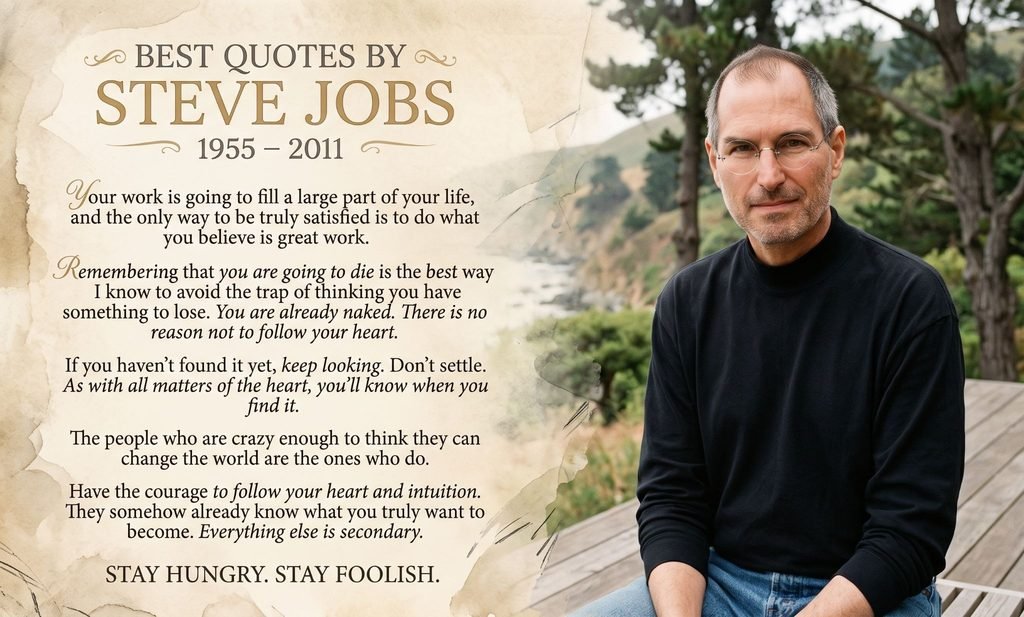
Life becomes more meaningful when you make choices that reflect your own values. Steve Jobs often spoke about the limited nature of time and the importance of deciding how to use it. His 2005 Stanford commencement address remains especially memorable because it connected personal loss, career setbacks, and curiosity with the bigger question of how to live.
1. Your life becomes more meaningful when your choices reflect your deepest values. Spend your time on things you would still care about years from now.
2. Time is too valuable to spend every day chasing someone else’s expectations. Choose a direction that feels honest to you.
3. A meaningful life is built through ordinary decisions made with care. The small things you do consistently often matter more than dramatic moments.
4. Purpose grows when you connect your abilities with something that helps others. Your talents become more valuable when you use them thoughtfully.
5. You do not need to understand your entire future before taking the next step. Curiosity can guide you toward opportunities you cannot yet imagine.
6. Life becomes clearer when you stop measuring your worth against everyone else’s progress. Your path can be different without being less valuable.
7. Pay attention to the experiences that make you feel genuinely alive. They may reveal what deserves more space in your life.
8. Meaning does not always come from achieving something impressive. Sometimes it comes from doing useful work and caring for the people around you.
9. Your past can teach you without controlling your future. Use what you have learned to make wiser choices today.
10. A life well lived is not measured only by what you own. It is also measured by what you create and the people whose lives you improve.
Steve Jobs Quotes About Leadership and Great Teams
Leadership is not simply about holding authority or making decisions for other people. It involves setting clear standards, building trust, communicating a vision, and helping talented people do their best work. Steve Jobs’s career at Apple and Pixar showed how creative teams can achieve ambitious goals when they share a strong sense of purpose.
1. Strong leadership begins with a clear vision and honest communication. People work with greater confidence when they understand the purpose behind their tasks.
2. A great leader helps talented people become even better at what they do. Support and high standards can exist together.
3. Teams achieve more when members respect different skills and viewpoints. Collaboration turns individual strengths into shared progress.
4. Leadership means accepting responsibility when a decision goes wrong. Blaming others weakens trust and prevents useful learning.
5. A healthy team values thoughtful disagreement over automatic agreement. Different perspectives can reveal weaknesses before they become expensive mistakes.
6. Great managers create conditions in which people can do excellent work. They remove unnecessary obstacles and make expectations clear.
7. Trust grows when leaders follow the standards they expect from others. Your actions often communicate more than your instructions.
8. A shared purpose helps a team stay focused during difficult periods. People are more willing to work through challenges when they understand why the effort matters.
9. The best leaders remain willing to learn from the people they lead. Listening carefully can uncover solutions that authority alone would never produce.
10. An organization’s long-term strength depends on the people it develops. Building future leaders is just as important as achieving today’s targets.
Steve Jobs Quotes on Passion and Loving What You Do
Passion can make difficult work feel worthwhile, but it does not remove the need for discipline. Steve Jobs repeatedly emphasized the importance of caring deeply about your work. His approach suggests that meaningful careers often develop when personal interest, useful skills, and a genuine need come together.
1. Great work becomes easier to sustain when you care about its purpose. Interest gives you a reason to keep improving after the excitement fades.
2. Passion is more than feeling excited about an idea. It is the willingness to keep working when progress becomes slow.
3. Loving your work does not mean every day will be enjoyable. It means the larger purpose makes the difficult days worth facing.
4. Your interests can point toward opportunities you have not considered yet. Follow your curiosity and see which skills grow through practice.
5. A meaningful career combines what you enjoy with what you can contribute. The strongest opportunities often emerge where personal interest meets a real need.
6. Enthusiasm can help a team move forward during uncertain times. Pair that energy with preparation and realistic expectations.
7. Do not confuse passion with rushing into every new idea. Give your interests enough time to develop into useful abilities.
8. Work feels more rewarding when you can see the value it creates. Knowing that your effort helps someone can renew your motivation.
9. You may need to try different paths before discovering work that fits you. Each experience can teach you something about your strengths and priorities.
10. Passion grows when you invest in a craft instead of waiting for inspiration. Practice gives your enthusiasm the skills it needs to produce results.
Steve Jobs Quotes About Creativity and Design
Steve Jobs helped make design an important part of how people evaluate technology. At Apple, appearance mattered, but so did usability, simplicity, and the experience of interacting with a product. His approach showed that thoughtful design is not merely decoration; it helps people understand and use something more easily.
1. Good design makes a useful idea easier to understand. Its beauty comes partly from how naturally it serves the person using it.
2. Creativity grows when you pay attention to details other people overlook. Everyday experiences can provide unexpected inspiration for new ideas.
3. Simplicity takes effort because it requires careful choices. Removing unnecessary elements can be harder than adding more features.
4. A product should work well before it tries to impress people. Appearance matters most when it supports the experience rather than distracting from it.
5. Original ideas often come from combining knowledge across different fields. Learn beyond your specialty and look for connections between seemingly unrelated subjects.
6. Details shape how people experience the whole product. A confusing button or unclear instruction can weaken an otherwise excellent design.
7. Creative thinking requires both imagination and judgment. Generate possibilities freely, then test which ones actually solve the problem.
8. A clean design gives the important elements room to stand out. Every choice should have a reason for being there.
9. Great design begins with understanding the person who will use the result. Listen to their needs before deciding what the solution should look like.
10. Creativity becomes valuable when an idea moves beyond imagination. Build a prototype, gather feedback, and improve the result through repeated testing.
Steve Jobs Quotes on Failure, Risk, and Resilience
Steve Jobs’s professional journey included major setbacks, including his departure from Apple in 1985 and his return in 1997. His experiences show that failure can change a person’s direction without ending their potential. A difficult outcome may reveal weaknesses, challenge assumptions, or create room for a different approach.
1. Failure can become useful when you examine what went wrong. Honest reflection helps you make a stronger decision the next time.
2. A setback does not have to define the rest of your story. It can become one chapter in a much longer journey.
3. Risk is part of creating something new. Reduce avoidable uncertainty through preparation without expecting every outcome to be predictable.
4. Resilience means adapting when your original plan stops working. Keep the goal in view while remaining flexible about the route.
5. Mistakes reveal the difference between what you assumed and what actually happened. Treat that information as a chance to improve.
6. You can begin again without pretending the past never happened. Carry the lessons forward and leave behind the habits that no longer serve you.
7. Courage is not the absence of fear. It is the decision to act carefully even when the result remains uncertain.
8. A rejected idea may need better timing or a different approach. Listen to criticism without allowing every opinion to determine your worth.
9. Growth often starts when familiar success disappears. New challenges can force you to learn skills that comfort never demanded.
10. Persistence works best when it includes honest evaluation. Continue when the goal still makes sense and change course when the evidence calls for it.
Steve Jobs Quotes About Focus and the Power of Saying No
Focus was an important part of Steve Jobs’s approach to product development. When he returned to Apple in 1997, the company simplified its product strategy and concentrated on fewer priorities. This history illustrates a useful business lesson: spreading resources across too many projects can weaken the quality of every one.
1. Focus begins when you decide which goals matter most. Clear priorities help you spend your energy where it can make the greatest difference.
2. Saying no protects the time needed for your best work. Every commitment should be weighed against the goals you already have.
3. Too many priorities can make important work harder to finish. Choose a manageable number of goals and give them your attention.
4. Simplicity often begins with removing distractions. Keep the tools, tasks, and habits that support your purpose.
5. A busy schedule does not automatically produce meaningful results. Measure progress by what you accomplish rather than how occupied you feel.
6. Good decisions require knowing what you are willing to leave undone. Trade-offs become easier when you understand the value of your main goal.
7. Focus improves when you protect time for uninterrupted thinking. Give challenging tasks your full attention instead of dividing it constantly.
8. Not every attractive opportunity deserves a yes. Consider whether it fits your long-term direction before committing.
9. Clear priorities make teamwork more effective. People can coordinate better when they understand which results matter most.
10. Focus is a habit that must be renewed every day. Review your commitments regularly and remove those that no longer serve your goals.
Steve Jobs Quotes on Thinking Differently and Challenging Norms
Steve Jobs became closely associated with the idea of thinking differently. Apple’s famous Think Different campaign celebrated people who challenged conventional ideas and imagined new possibilities. The message was not simply to disagree with everyone; it was to question assumptions and look for better ways to solve problems.
1. Independent thinking begins when you question assumptions instead of accepting them automatically. Ask what evidence supports an idea before deciding whether it deserves your trust.
2. Original ideas often appear strange before people understand their value. Give thoughtful experiments a chance before dismissing them.
3. You do not have to reject every tradition to think differently. Keep what works and improve what no longer meets people’s needs.
4. Curiosity helps you notice possibilities that routine thinking can hide. Ask better questions and remain open to surprising answers.
5. The courage to disagree can lead to useful discoveries. Express your ideas respectfully and support them with clear reasoning.
6. Being different is not a goal by itself. The real value comes from offering a perspective that helps solve a problem.
7. New opportunities often emerge when you look beyond familiar examples. Study different industries and experiences to expand your understanding.
8. Independent thinkers remain willing to change their minds. Strong judgment comes from following evidence rather than defending every first impression.
9. Challenging the status quo requires patience and persistence. Explain your reasoning clearly and show how a new approach could work.
10. Thinking differently becomes powerful when it leads to meaningful action. Turn original ideas into practical experiments that people can evaluate.
Steve Jobs Quotes About Death, Time, and Living Fully
Steve Jobs spoke openly about mortality in his 2005 Stanford commencement address. He explained how remembering that life is limited had influenced his decisions. His words encouraged listeners to look beyond social expectations and consider whether they were spending their time on things that truly mattered.
1. Remembering that time is limited can help you choose your priorities. Give more attention to the people and activities that matter to you.
2. Life becomes more meaningful when you stop postponing every important decision. Take a realistic first step toward the change you have been considering.
3. Your time deserves the same care you give your money. Spend it intentionally instead of allowing every distraction to claim a share.
4. Mortality reminds us that ordinary moments have value. Appreciate meaningful conversations and experiences while you have the chance.
5. You cannot control how long every journey will last. You can make thoughtful choices about how you live today.
6. Fear of judgment can keep people trapped in unwanted routines. Consider whose expectations you are following and whether they align with your values.
7. A meaningful legacy develops through actions rather than grand promises. Help people, share what you know, and create work that remains useful.
8. Time spent caring for others is rarely wasted. Relationships often give achievements their deeper meaning.
9. You do not need to wait for a major life event to reconsider your direction. Regular reflection can help you notice when your priorities have changed.
10. Living fully does not mean filling every moment with activity. It means giving your attention to experiences that make life worthwhile.
Steve Jobs Quotes About Following Your Dreams
Following your dreams requires more than imagining a better future. It asks you to identify what matters, build relevant skills, and accept that the path may change along the way. Steve Jobs’s career offers an example of how curiosity and experimentation can lead to unexpected opportunities.
1. A dream becomes more achievable when you turn it into a specific plan. Choose one small action you can complete this week.
2. Following your heart requires honest reflection about what matters to you. Separate your own ambitions from expectations you have accepted without question.
3. You do not need perfect confidence before you begin. Take the first reasonable step and let experience strengthen your judgment.
4. Dreams become stronger when supported by useful skills. Learn what your goal requires and practice those abilities consistently.
5. The path toward an ambition may look different from what you imagined. Treat unexpected changes as information rather than automatic signs of failure.
6. Your progress does not need to match anyone else’s timeline. Build habits that suit your circumstances and keep moving at a sustainable pace.
7. A worthwhile dream should leave room for learning. Stay curious enough to improve the goal as your understanding grows.
8. Courage means taking thoughtful action despite uncertainty. Prepare carefully, consider the risks, and begin when the opportunity makes sense.
9. You can pursue a meaningful goal without having every answer today. Keep testing your assumptions as new experiences teach you more.
10. Your ambitions deserve action rather than endless postponement. Start with what you have and improve your approach as you learn.
Steve Jobs Quotes on Business and Entrepreneurship
Steve Jobs’s business career included the creation of Apple, the development of NeXT, and his leadership role at Pixar. These experiences show that entrepreneurship involves more than launching a product. It requires understanding customers, building teams, managing resources, and making difficult decisions when the future is uncertain.
1. A strong business starts with a problem worth solving. Understand the people affected before deciding what product or service to build.
2. Entrepreneurship requires more than a promising idea. Execution, customer feedback, and consistent improvement determine whether the idea creates value.
3. A company’s reputation grows through the experiences it delivers. Keep your promises and make quality part of the daily process.
4. Business growth becomes healthier when it follows real customer needs. Avoid adding features or services simply because competitors have them.
5. Good founders know which opportunities fit their strategy. A smaller number of well-executed projects can be more valuable than constant expansion.
6. A useful product must offer a clear reason for people to choose it. Explain its value in language customers can understand.
7. Innovation becomes a business advantage when it improves the customer experience. Creativity should lead to something people genuinely find useful.
8. Business setbacks can reveal weaknesses in your original plan. Review the evidence and make changes before small problems become larger ones.
9. Strong companies depend on people who share responsibility for results. Build a culture where thoughtful feedback and reliable work are valued.
10. Sustainable entrepreneurship combines ambition with careful decisions. Protect your long-term purpose while adapting to changing customer needs.
Steve Jobs Quotes About Learning From Mistakes
Mistakes are an unavoidable part of trying new things. What matters is how you respond when your expectations do not match reality. Steve Jobs experienced major professional setbacks, and his career demonstrates the value of reassessing decisions rather than assuming that one failure determines every future outcome.
1. A mistake becomes a lesson when you understand why it happened. Look beyond the immediate result and examine the decision that produced it.
2. Honest feedback can reveal weaknesses you cannot see yourself. Listen carefully before deciding which changes will improve your work.
3. Repeating a mistake without reflection wastes a valuable opportunity. Record what you learned and use it to guide your next attempt.
4. Taking responsibility gives you more control over what happens next. Acknowledge your part and focus on the actions you can change.
5. Failure can challenge your confidence without removing your abilities. Give yourself time to recover and then review the situation objectively.
6. Good judgment develops through experience and reflection. Learn to distinguish between a poor decision and an outcome nobody could reasonably predict.
7. Mistakes can reveal where your process needs improvement. Build checks and habits that make the same problem less likely to happen again.
8. Criticism is most useful when it identifies a specific issue. Turn general disappointment into clear questions you can investigate.
9. Growth requires the willingness to admit when an old approach no longer works. Changing your method is a sign of learning rather than weakness.
10. Progress does not require a perfect record. It requires using experience to make better decisions over time.
Steve Jobs Quotes on Simplicity and Minimalism
Simplicity was a defining principle of Apple’s product philosophy. The aim was not to remove features at random but to make technology easier to understand and use. That requires careful thinking because every additional option, instruction, or design element can affect the overall experience.
1. Simplicity begins with understanding the real purpose of a product. Once that purpose is clear, unnecessary elements become easier to identify.
2. A simple solution often requires more thought than a complicated one. Clear results usually come from making difficult choices carefully.
3. Remove anything that makes the main task harder to understand. Give people a direct path toward the result they need.
4. Minimalism works best when it improves usefulness. Do not remove something valuable merely to make a design look cleaner.
5. Clear communication respects the reader’s time. Use direct language and organize information so the main point is easy to find.
6. A focused workspace can make important tasks easier to manage. Keep the tools you need nearby and reduce avoidable distractions.
7. Simplicity creates space for quality to stand out. When unnecessary details disappear, people can pay attention to what matters.
8. Good design makes complicated processes feel more natural. Test your work with real users to find places where they struggle.
9. A simpler plan is often easier to explain and maintain. Choose a practical process that people can follow consistently.
10. Simplicity is a continuing discipline rather than a one-time decision. Review your work and keep removing obstacles that no longer serve a purpose.
Steve Jobs Quotes About Technology and the Future
Steve Jobs helped shape modern technology by focusing on how people interact with digital products. His work at Apple connected hardware, software, and design in ways that changed personal computing and mobile communication. His career also showed that technology matters most when it offers a useful experience rather than simply displaying technical complexity.
1. Technology is most useful when it helps people accomplish something meaningful. Measure its value by the problems it solves rather than its complexity.
2. The future belongs to people who keep learning as tools change. Build adaptable skills instead of relying on one method forever.
3. A powerful product combines technical ability with human understanding. Engineers and designers create better experiences when they work toward a shared purpose.
4. New technology should make important tasks easier to complete. Innovation has limited value when people cannot understand or use the result.
5. Progress often happens when different fields share ideas. Combine technical knowledge with design, communication, and an understanding of human behavior.
6. The next useful invention may begin with an everyday frustration. Pay attention to problems that people have learned to accept as normal.
7. Technology should support human creativity rather than replace thoughtful judgment. Use digital tools to extend your abilities and make better decisions.
8. The best products balance powerful capabilities with clear experiences. Give users the features they need without overwhelming them with unnecessary choices.
9. Future opportunities belong to curious people who keep experimenting. Explore new tools carefully and learn how they can serve real needs.
10. Innovation matters when it improves people’s lives in practical ways. Build technology with a clear purpose and a responsibility toward those who use it.
Steve Jobs Quotes on Teamwork and Collaboration
Creative achievements rarely come from one person working entirely alone. Apple’s products depended on engineers, designers, programmers, marketers, and many other specialists. Pixar’s success also demonstrated the importance of collaboration, storytelling, and the different talents required to turn an ambitious idea into a finished product.
1. Great teams combine different strengths to solve difficult problems. Give each person a meaningful role and respect the skills they bring.
2. Collaboration works best when everyone understands the shared goal. Clear expectations help people coordinate their efforts without unnecessary confusion.
3. Different viewpoints can improve a project when people listen carefully. Encourage discussion that focuses on ideas rather than personal criticism.
4. Trust grows when team members keep their commitments. Reliable actions make collaboration easier than promises alone.
5. A talented team needs both freedom and direction. Set clear goals while allowing people to choose effective ways to achieve them.
6. Good teamwork includes the courage to raise concerns early. Discuss problems before they grow into larger disagreements.
7. Shared success depends on recognizing other people’s contributions. Give credit fairly and make appreciation part of your working culture.
8. Strong leaders help people learn from one another. Knowledge sharing makes the whole team more capable.
9. Collaboration becomes more effective when responsibilities are clear. Define who makes decisions and how progress will be reviewed.
10. A team becomes stronger when it treats setbacks as shared learning opportunities. Focus on improving the process instead of searching for someone to blame.
Steve Jobs Quotes About Education and Lifelong Learning
Steve Jobs’s interest in design, technology, and the liberal arts reflected the value of learning beyond a single subject. His experience at Reed College, including his exposure to calligraphy, later influenced the typography and visual design associated with the Macintosh. This is a useful reminder that knowledge gained outside your main field can become valuable in unexpected ways.
1. Learning becomes more valuable when you apply it to real problems. Turn new information into practice instead of letting it remain an abstract idea.
2. Curiosity can lead you toward knowledge you never expected to need. Explore subjects that interest you even when their immediate value is unclear.
3. Education should strengthen your ability to ask useful questions. Understanding a problem often matters as much as memorizing its answer.
4. Every new skill can create connections with what you already know. Look for ways to combine your knowledge across different fields.
5. Mistakes are part of learning something difficult. Give yourself room to practice and improve without expecting immediate mastery.
6. Reading widely can introduce you to unfamiliar perspectives. Different viewpoints help you question assumptions and think more clearly.
7. Lifelong learning keeps your abilities relevant as the world changes. Set aside regular time to develop skills that support your goals.
8. Teachers and mentors can guide you, but curiosity must continue beyond the classroom. Take responsibility for exploring questions that matter to you.
9. Knowledge becomes more powerful when you share it with others. Explain what you learn and listen to the questions people ask.
10. A strong learner remains open to changing their understanding. Let new evidence improve your thinking rather than defending outdated beliefs.
Steve Jobs Quotes on Trusting Your Intuition
Intuition played an important role in how Steve Jobs described his decisions and creative process. He often spoke about trusting his instincts while drawing on his experience and judgment. Intuition can be useful when a situation is complex, but it works best when combined with knowledge, reflection, and an awareness of possible risks.
1. Intuition can help you notice patterns before you can explain them clearly. Use that first impression as a reason to investigate further.
2. Trust grows when you understand your own values. Clear priorities make it easier to recognize which opportunities feel right for you.
3. Your instincts are more useful when informed by experience. Learn from previous decisions so your judgment becomes more reliable.
4. A strong feeling does not always mean a decision is correct. Check the facts before taking action when the consequences are significant.
5. Listening to yourself can help you recognize when a path no longer fits. Take time to understand the reasons behind that feeling.
6. Intuition and analysis can work together. Let your instincts suggest possibilities and use evidence to evaluate them.
7. You do not need everyone’s approval to make a thoughtful decision. Consider useful feedback while remaining responsible for your own choices.
8. Quiet reflection can help you separate genuine preferences from outside pressure. Give yourself time to think before committing to an important direction.
9. Experience teaches you which signals deserve attention. Review past outcomes to learn when your judgment was helpful and when it was mistaken.
10. Trusting yourself means accepting responsibility for your choices. Stay willing to adjust when new information changes what you know.
Steve Jobs Quotes About Taking Risks and Being Bold
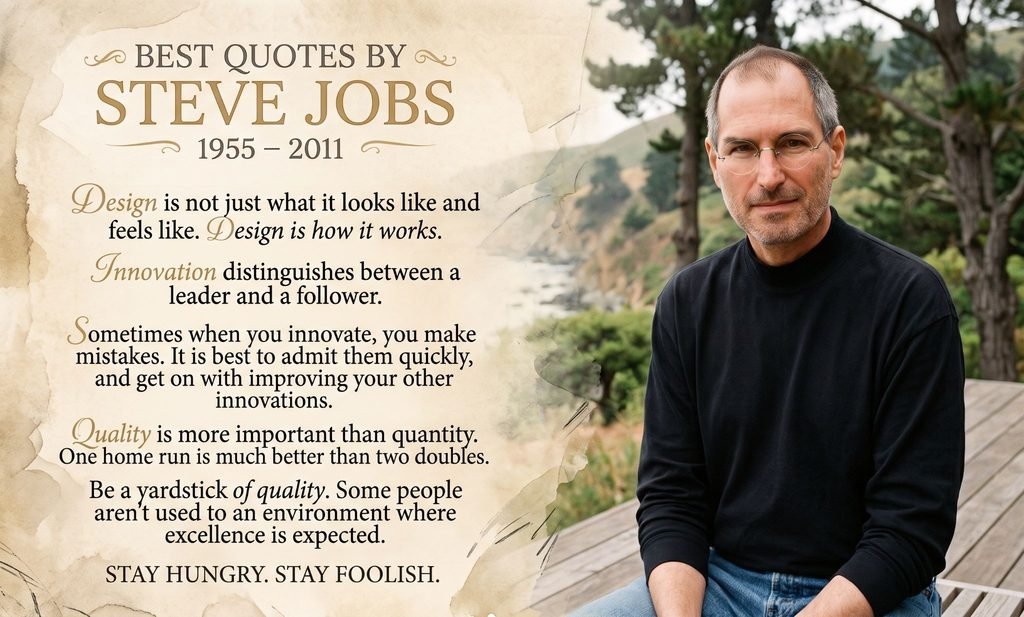
Innovation requires a willingness to act without knowing every outcome in advance. Steve Jobs pursued ambitious ideas in personal computing, digital media, and mobile technology, often in markets where success was far from guaranteed. His career illustrates the value of calculated risk-taking, but it also reminds us that ambition needs judgment and preparation.
1. Every worthwhile opportunity carries some uncertainty. Understand the risks before deciding whether the possible reward justifies them.
2. Courage becomes more effective when paired with preparation. Build the skills and knowledge that give your bold decisions a stronger foundation.
3. Staying comfortable can prevent you from discovering new abilities. Try challenges that stretch your skills without ignoring your responsibilities.
4. A new idea deserves a fair test before it is dismissed. Start with a manageable experiment and learn from the results.
5. Risk-taking works best when the purpose is clear. Know what you hope to achieve and what you are willing to lose.
6. Fear can provide useful information without needing to control your decision. Identify the danger and decide how to manage it.
7. Bold thinking challenges the limits people accept without question. Ask whether those limits are necessary or simply familiar.
8. You can make progress without being certain of success. Choose a sensible first step and review the evidence as you go.
9. Not every risk is worth taking. Protect what matters while making room for opportunities that fit your long-term goals.
10. Growth often requires a decision that feels unfamiliar at first. Give yourself the chance to learn what becomes possible through action.
Steve Jobs Quotes on Motivation and Personal Growth
Personal growth comes from learning to work with your strengths while improving the areas that hold you back. Steve Jobs’s career included periods of achievement, conflict, reinvention, and renewed success. His experiences show that development is rarely a straight line and that progress often depends on curiosity, honest reflection, and the willingness to begin again.
1. Personal growth begins when you become honest about what needs to change. Choose one area for improvement and give it consistent attention.
2. Motivation is useful, but habits keep your goals moving forward. Build a routine that supports progress even when enthusiasm is low.
3. Your current abilities do not define your future potential. Practice deliberately and give yourself time to develop new strengths.
4. Progress becomes easier to recognize when you measure small improvements. Celebrate useful steps without losing sight of the larger goal.
5. Confidence grows through experience rather than wishful thinking alone. Take on manageable challenges and learn from what happens.
6. Growth requires the courage to question your own habits. Keep the practices that help you and change those that repeatedly create problems.
7. You can learn something useful from almost every difficult experience. Reflect on what happened and decide how to apply the lesson.
8. Personal development is not a competition with everyone around you. Compare your current choices with the person you want to become.
9. A fresh start can begin with a single better decision. You do not need to fix everything at once to move forward.
10. The strongest progress combines ambition with patience. Keep working toward meaningful goals while allowing yourself time to improve.
Steve Jobs Quotes About Finding Your Passion in Life
Finding your passion is not always an immediate or dramatic experience. Many people discover what they care about through work, hobbies, education, and everyday responsibilities. Steve Jobs encouraged people to seek work they could believe in, but the process of finding that work can involve experimentation and gradual discovery.
1. Passion often becomes clearer through experience. Try different activities and notice which ones continue to interest you after the novelty fades.
2. Your interests can guide you toward work that feels meaningful. Explore how those interests might connect with useful skills and real opportunities.
3. You do not need one perfect passion to build a rewarding life. Several interests can contribute to a career that suits your values.
4. Loving your work starts with understanding what matters to you. Identify the parts of your day that feel useful, engaging, or worthwhile.
5. Curiosity can be the beginning of a deeper commitment. Follow the questions that encourage you to learn and practice.
6. Passion becomes stronger when you develop competence. Invest time in your craft instead of expecting interest alone to produce excellent results.
7. A meaningful path can change as your circumstances change. Allow your priorities to develop without treating every change as a failure.
8. Your passion does not have to impress other people. Choose goals that make sense for your own life and responsibilities.
9. Work feels more satisfying when it connects with a purpose you value. Look for ways to make your daily effort useful to someone.
10. Finding your direction takes both reflection and action. Experiment, review what you learn, and keep moving toward a better fit.
Steve Jobs Quotes on Making a Difference in the World
Steve Jobs’s work influenced how millions of people use technology, communicate, listen to music, and create digital content. His career demonstrates how a focused idea can grow into something with a much wider impact. Yet making a difference does not always require founding a major company or inventing a revolutionary product.
1. Making a difference begins with noticing a problem worth solving. Look for a practical way to help the people affected by it.
2. Meaningful contributions often start on a small scale. Improve one process or support one person before worrying about a larger impact.
3. Your skills become more valuable when they serve a genuine need. Use what you know to make someone’s task easier or their experience better.
4. Lasting change requires more than a powerful idea. Build a practical plan and keep improving it as you learn.
5. You do not need public recognition to create something worthwhile. Quiet contributions can have a meaningful effect on people’s lives.
6. Progress grows when people share knowledge and resources. Look for opportunities to collaborate with others who care about the same problem.
7. A useful invention can change how people approach an everyday challenge. Start by understanding what makes that challenge difficult.
8. The quality of your work influences the value it creates. Take responsibility for making your contribution thoughtful and reliable.
9. Positive change often requires patience and persistence. Keep evaluating your efforts and adjust your approach when necessary.
10. A meaningful legacy is built through repeated actions. Focus on the people you help and the value that remains after your work is done.
Steve Jobs Quotes About Customer Experience and Great Products
Steve Jobs’s approach to product development placed strong emphasis on the complete customer experience. At Apple, the goal was not simply to sell advanced technology but to make products that people could understand, enjoy, and use effectively. This meant considering the design, functionality, packaging, and relationship between hardware and software.
1. A great product solves a problem people genuinely care about. Understand the customer’s needs before deciding which features to build.
2. Customer experience begins before someone buys the product. Clear information and honest promises help people make confident decisions.
3. Good design makes a product easier to use. Remove unnecessary steps and help customers reach their goals without confusion.
4. Quality must continue after the initial sale. Reliable support helps customers feel that their decision was worthwhile.
5. Customer feedback can reveal problems that internal teams overlook. Listen carefully and separate useful patterns from isolated preferences.
6. A product should deliver the value its marketing promises. Consistency between expectations and experience helps build long-term trust.
7. Features matter when they improve the customer’s experience. Avoid adding complexity simply to make a product appear more advanced.
8. Small frustrations can affect how people feel about an entire brand. Test the full customer journey and fix avoidable obstacles.
9. Great products are shaped by repeated improvement. Use feedback and real-world testing to make each version more useful.
10. Customer loyalty grows when a product continues to meet real needs. Keep listening after launch and remain willing to improve.
Steve Jobs Quotes on Connecting the Dots in Life
Connecting the dots is one of the most recognizable ideas associated with Steve Jobs’s 2005 Stanford commencement address. He explained that people often understand the importance of earlier experiences only when they look backward. His story about taking a calligraphy class at Reed College illustrated how knowledge that seems unrelated at first can influence later work.
1. You may understand an experience’s value only after time has passed. Keep learning even when the immediate purpose is not obvious.
2. Different experiences can connect in unexpected ways. Explore interests beyond your main field and remain open to new combinations.
3. Your past can offer clues without determining your future. Use what you have learned to make more informed choices.
4. A career does not always follow a straight line. Skills developed in one role may become useful in another.
5. Curiosity can create opportunities that careful planning alone might miss. Follow worthwhile interests and see where they lead.
6. An unexpected setback can reveal a different direction. Give yourself time to understand what the experience has taught you.
7. Learning across different subjects helps you see broader patterns. Connect ideas from different fields to approach problems creatively.
8. You do not need to explain every decision before making it. Choose thoughtfully and review what each experience teaches you.
9. Looking backward can help you recognize patterns in your choices. Use those patterns to understand what motivates and challenges you.
10. Your experiences gain meaning through how you use them. Turn lessons from the past into better decisions for the future.
Steve Jobs Quotes About Staying Hungry and Staying Foolish
“Stay Hungry. Stay Foolish.” is the closing message of Steve Jobs’s 2005 Stanford commencement address. He borrowed the phrase from the final issue of The Whole Earth Catalog, a publication that celebrated curiosity, independence, and alternative ways of thinking. The message encourages people to keep learning and remain open to possibilities, even after they achieve success.
1. Stay curious even when you become skilled at your work. There is always another perspective that can improve your understanding.
2. Success should create new questions rather than end your desire to learn. Keep looking for ways to improve what you already know.
3. The willingness to begin again can open unexpected doors. Treat unfamiliar experiences as opportunities to develop new abilities.
4. Do not allow past achievements to make you afraid of experimentation. Protect your standards while remaining open to better methods.
5. Curiosity helps you notice possibilities beyond your current plans. Ask questions that challenge your assumptions and expand your thinking.
6. Humility makes learning easier because it leaves room for correction. Accept that someone else may understand a problem better than you do.
7. Ambition becomes healthier when it is balanced with curiosity. Pursue meaningful goals while continuing to explore new ideas.
8. A beginner’s mindset helps you see familiar problems differently. Approach each challenge with attention rather than relying only on habit.
9. Progress requires both confidence and a willingness to be wrong. Make thoughtful attempts and use the results to improve.
10. Keep learning after others begin to recognize your achievements. The desire to grow can keep your work relevant and rewarding.
Short Steve Jobs Quotes for Daily Inspiration
Short quotes can offer a quick reminder when you need encouragement during a busy day. Steve Jobs’s public speeches and interviews contain several memorable lines about creativity, time, innovation, and work. Their appeal comes partly from their simplicity: a few words can express an idea that deserves much deeper thought.
1. Make your work matter. Give ordinary tasks the attention they deserve.
2. Stay curious about the world. New questions can lead to better ideas.
3. Choose quality over noise. Let the value of your work speak clearly.
4. Focus on what matters. Give your best attention to your most important goals.
5. Learn from every setback. Use the lesson to make your next decision wiser.
6. Keep your ideas simple. Remove distractions so the essential message stands out.
7. Build with purpose. Create something that solves a real problem.
8. Trust your ability to learn. You can improve through practice and honest feedback.
9. Respect the value of time. Spend it on people and work that matter.
10. Stay open to change. A better direction may appear when you keep learning.
Famous Steve Jobs Quotes That Everyone Should Know
Steve Jobs is remembered not only for the products associated with Apple but also for his public speeches and reflections on creativity. His 2005 Stanford commencement address remains a major part of his public legacy. It covered three themes: connecting the dots, love and loss, and remembering that life is limited.
1. “Innovation distinguishes between a leader and a follower.” This well-known line expresses the importance Jobs placed on creating new value rather than simply copying others.
2. “Stay hungry. Stay foolish.” The closing message of the 2005 Stanford commencement address encourages curiosity and a willingness to keep learning.
3. “Your time is limited, so don’t waste it living someone else’s life.” This line from his Stanford address urges people to think carefully about their own choices.
4. “The only way to do great work is to love what you do.” This familiar statement highlights the relationship between meaningful work and personal commitment.
5. “Creativity is just connecting things.” This short line captures the importance of recognizing relationships between ideas and experiences.
6. “I’m as proud of many of the things we haven’t done as the things we have done.” This statement reflects the importance of choosing priorities and resisting unnecessary complexity.
7. “Remembering that I’ll be dead soon is the most important tool I’ve ever encountered to help me make the big choices in life.” Jobs used this idea to explain how mortality influenced his decisions.
8. “Sometimes life hits you in the head with a brick. Don’t lose faith.” This line from his Stanford speech reflects his response to unexpected setbacks.
9. “You can’t connect the dots looking forward; you can only connect them looking backwards.” This idea explains why the value of some experiences becomes clearer with time.
10. “Have the courage to follow your heart and intuition.” Jobs used this advice to encourage listeners to pay attention to their inner sense of direction.
Best Steve Jobs Quotes About Work and Career
A satisfying career is built through more than promotions or a higher salary. It also depends on the skills you develop, the problems you solve, and the quality of the work you produce. Steve Jobs’s career shows how personal interests can influence professional decisions and how unexpected changes can open a new direction.
1. A meaningful career grows when your work connects with your values. Look for responsibilities that help you develop while contributing something useful.
2. Professional growth depends on the quality of your effort. Build a reputation for reliable work rather than relying only on appearances.
3. Your first career choice does not have to determine your entire future. Stay open to opportunities that fit your changing interests and abilities.
4. Good work requires both skill and judgment. Learn the technical details while understanding the needs your work is meant to serve.
5. A job becomes more rewarding when you can see its impact. Pay attention to how your contribution helps customers, colleagues, or the wider community.
6. Career setbacks can help you reconsider what matters. Review your options and use the experience to make a more informed next move.
7. Keep developing your abilities even when your current role feels comfortable. New skills can prepare you for opportunities that have not appeared yet.
8. Professional confidence grows when you take responsibility for your results. Be honest about mistakes and consistent about delivering what you promise.
9. Do not measure your entire career by one difficult period. Give yourself time to learn, adapt, and discover better opportunities.
10. The strongest careers combine purpose with continuous improvement. Keep asking how your work can become more useful, effective, and meaningful.
Steve Jobs Quotes on Vision, Innovation, and the Future
Steve Jobs quotes on vision and innovation can help you think beyond immediate challenges. A vision is not simply an ambitious statement; it needs a practical plan, clear priorities, and a willingness to revise assumptions. Whether you are developing a product or planning your career, combine imagination with evidence so that your ideas can become achievable goals.
1. A strong vision gives daily work a clear direction. Connect individual tasks to the larger outcome you want to create.
2. Innovation begins by imagining a better experience. Study current limitations and identify how they might be removed.
3. Future opportunities often emerge from problems people have not yet solved well. Listen closely to users and look for needs that remain unmet.
4. Vision requires more than predicting what might happen. Build something useful and learn from how people respond to it.
5. A clear purpose helps teams make difficult trade-offs. When priorities are understood, decisions become easier to evaluate.
6. Creative ideas need practical foundations. Test assumptions, manage resources, and develop a realistic path toward implementation.
7. Long-term thinking helps you avoid chasing every temporary trend. Choose opportunities that support your broader goals and values.
8. The future becomes easier to shape when you remain willing to learn. Update your knowledge as technology and customer expectations change.
9. A meaningful vision should improve something beyond the creator’s reputation. Consider who benefits from the result and how you will know it works.
10. Innovation is an ongoing process rather than a final achievement. Keep evaluating what people need and improving the solutions you provide.
Most Inspiring Steve Jobs Quotes to Live By
Use these Steve Jobs motivational quotes and original reflections as prompts for personal growth rather than rules you must follow in every situation. You can write one in a journal, discuss it with a friend, or use it to reflect on a decision you have been postponing. The goal is not to copy someone else’s life but to think more clearly about your own.
1. Build a life that reflects what matters to you. Make choices that you can explain honestly to yourself.
2. Keep learning when the path becomes uncertain. New knowledge can reveal options you could not see before.
3. Let difficult experiences teach you without defining you. Take the lesson and give yourself permission to move forward.
4. Create work you can stand behind. Care about its usefulness, its quality, and the people who will experience it.
5. Give your attention to the things that deserve it. Protect your time from distractions that repeatedly pull you away from your priorities.
6. Stay curious when you think you already know enough. A willingness to learn can keep your ideas fresh.
7. Choose progress over the appearance of perfection. Improve your work through practice and thoughtful feedback.
8. Follow meaningful goals with patience. Lasting achievements often take longer than the first plan suggests.
9. Use your abilities to make something better for others. A contribution becomes more meaningful when it solves a genuine problem.
10. Keep questioning whether your actions match your values. Small changes made consistently can lead to a more fulfilling life.
Frequently Asked Questions
What makes Best Steve Jobs Quotes so inspiring?
Best Steve Jobs Quotes inspire people to think differently, follow their passion, and believe in their ideas. They offer valuable lessons about life and success.
How can Best Steve Jobs Quotes motivate students?
Best Steve Jobs Quotes encourage students to stay curious, work hard, and learn from mistakes. They remind students that failure can lead to growth.
What are the main lessons in Best Steve Jobs Quotes?
Best Steve Jobs Quotes teach creativity, leadership, persistence, and innovation. They encourage people to trust their vision and create meaningful work.
Can Best Steve Jobs Quotes help business owners?
Yes, Best Steve Jobs Quotes can inspire business owners to take smart risks, solve problems, and build products that meet people’s needs.
Where can I share Best Steve Jobs Quotes?
You can share Best Steve Jobs Quotes on Instagram, Facebook, Pinterest, or LinkedIn. They also work well in presentations, captions, and motivational posts.
Conclusion
The Best Steve Jobs Quotes offer valuable lessons about success, creativity, and life. His words remind us to think differently, follow our passion, and believe in our ideas. Steve Jobs showed that hard work and fresh thinking can lead to great achievements. Every Steve Jobs quote carries a message that can inspire you to face challenges and keep moving forward. These words can motivate students, business owners, and anyone who wants to grow.
Use the Best Steve Jobs Quotes to find motivation in your daily life. Share your favorite lines with friends or post them on social media. Let these words remind you to stay curious, learn from mistakes, and create something meaningful. Success takes time, patience, and effort. Keep believing in yourself and take small steps toward your goals. Sometimes, one simple quote can change your mindset and inspire you to make a better choice.Read other article Best End of Treatment Bell Quotes

QuotesWhisper is a welcoming destination for inspiring quotes, meaningful messages, and uplifting words, managed by Ethan Parker, an SEO content writer with 2 years of experience, focused on creating simple, thoughtful, and engaging content that helps readers find the right words for every feeling and occasion.
1 thought on “150+ Best Steve Jobs Quotes About Success, Innovation, Life & Leadership”